Página principal
Localizar el contenido del sitio
    • Acerca del Observatorio Rubin
    • Historia
    • ¿Quién era Vera Rubin?
      • Rubin en Chile
      • Cerro Pachón
      • Selección del emplazamiento del observatorio
      • Organización del observatorio
      • Liderazgo
      • Colaboraciones científicas
      • Departments and teams
    • Información de financiamiento
      • Trabaje con nosotros
      • Trabajos
    • Información de contacto
    • Explore
      • Cómo funciona Rubin
      • Investigación del Espacio-Tiempo como Legado para la Posteridad (LSST)
      • Tecnología de Rubin
      • Flujo de alertas
      • Rubin en cifras
    • Objetivos científicos
      • Skyviewer ↗
      • Skysynth: El cosmos capturado por Rubin, para tus oídos
    • Orbitviewer ↗
    • Voces de Rubin
    • Involúcrate en la investigación de Rubin
      • Actividades, juegos y más
      • Juego Space Surveyors
      • Serie de videos animados
      • La foto grupal de 3.200 megapíxeles del Observatorio Rubin
    • Galería
      • Galería Principal
      • Primera Luz
      • Gráficos y Ilustraciones
      • Divulgación y Educación
    • Presentaciones de Diapositivas
    • Construction Archive Gallery
    • Media Use Policy
    • Noticias
    • Comunicados de Prensa
      • Primera Luz del Observatorio Vera Rubin
      • El cofre de tesoros cósmicos
      • Un enjambre de nuevos asteroides
      • Ritmo en las estrellas
      • Nebulosas Trífida y de la Laguna
      • Celebraciones de las primeras imágenes de Rubin
    • Recursos de medios
    • Comunicados de Prensa
    • Pautas de Estilo
    • Para los científicos
    • Ciencia ciudadana
    • Educación
    • Primera Luz: Recursos que Dejan Huella en el Aula
    • Preguntas frecuentes - Educación
    • Educadores
    • Glosario
    • Investigaciones
    • Calendario
Localizar el contenido del sitio

Conecta con nosotros

  • Visite el Observatorio Rubin en Facebook
  • Visite el Observatorio Rubin en Instagram
  • Visite el Observatorio Rubin en LinkedIn
  • Visite el Observatorio Rubin en Twitter
  • Visite el Observatorio Rubin en YouTube
  • Contáctenos
  • Trabaja con nosotros
  • Intranet (en inglés)
  • Guía de identidad visual (en inglés)
  • Política de privacidad

La Fundación Nacional de Ciencias (NSF) y la Oficina de Ciencias del Departamento de Energía (DOE) apoyarán al Observatorio Rubin en su fase de operaciones para conducir la Investigación del Espacio-Tiempo como Legado para la Posteridad. También apoyarán la investigación científica con los datos. Durante sus operaciones, el financiamiento de la NSF lo administra la Asociación de Universidades para la Investigación en Astronomía (AURA, por su sigla en inglés) bajo un acuerdo colaborativo con la NSF, y el financiamiento del DOE lo administra Laboratorio Nacional de Aceleradores SLAC (SLAC, por su sigla en inglés), bajo un contrato con el DOE. El Observatorio Rubin es operado por el Laboratorio Nacional de Investigación para la Astronomía Óptica-Infrarroja de la NSF (NOIRLab) y por el SLAC.

La NSF es una agencia independiente creada por el Congreso de los Estados Unidos en 1950 para promover el progreso de la ciencia. La NSF apoya la investigación básica y las personas para crear conocimiento que contribuya a la transformación del futuro.

La oficina de Ciencias de DOE es la mayor fuente de financiamiento de la investigación básica en ciencias físicas en los Estados Unidos y está trabajando para hacer frente a algunos de los retos más desafiantes de nuestro tiempo.

  1. Noticias
  2. Site in Northern Chile Selected for Large Synoptic
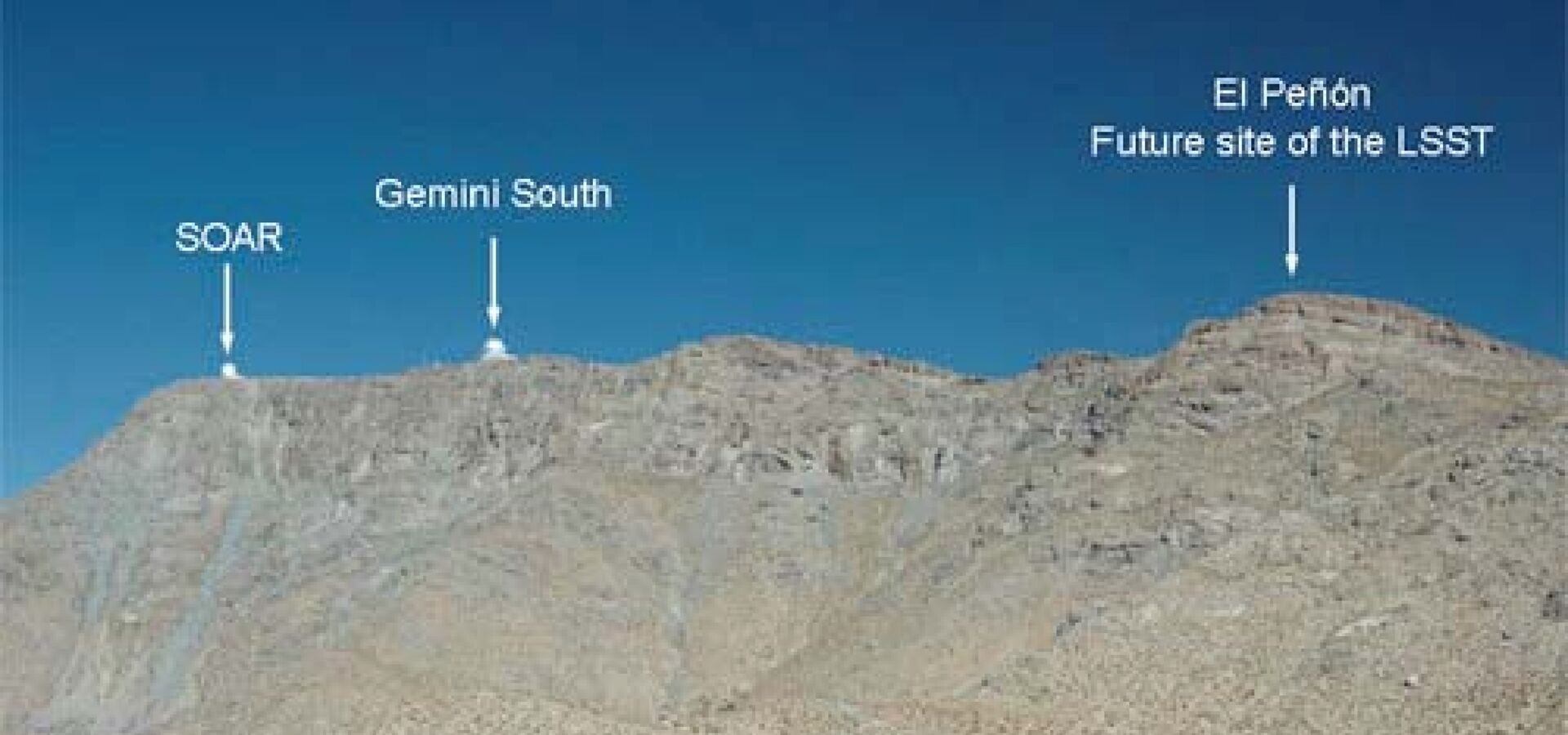
Future site of the LSST

Multimedia

Future site of the LSST
Schematic drawing of LSST on facility telescope site

Noticias relacionadas

Cargando las noticias...
Volver a noticias

Site in Northern Chile Selected for Large Synoptic

17 de mayo de 2006
Cerro Pachón, an 8,800-foot (2,682-meter) mountain peak in northern Chile, has been selected as the site for the proposed Large Synoptic Survey Telescope (LSST).

Scheduled to see “first light” in 2012, the 8.4-meter LSST will be able to survey the entire visible sky every three nights with its three-billion pixel digital camera, probing the mysteries of Dark Matter and Dark Energy, and opening a movie-like window on objects that change or move on rapid timescales: exploding supernovae, potentially hazardous near-Earth asteroids as small as 100 meters, and distant Kuiper Belt Objects.

The decision to place the LSST on Cerro Pachón follows a two-year campaign of in-depth testing and analysis of the atmospheric conditions and quality of astronomical “seeing” at four sites in Chile, Mexico, and the Canary Islands. The eleven members of the Site Selection Committee, chaired by Marc Sarazin from the European Southern Observatory, reviewed detailed proposals from two final sites, San Pedro Mártir in Baja California, Mexico, and Cerro Pachón, regarding their suitability for the project. The final selection of Cerro Pachón was made by the LSST Corporation Board of Directors based on a recommendation from the Site Selection Committee.

Important factors when considering a site for the LSST include the number of clear nights per year, seasonal weather patterns, and the quality of images as seen through the local atmosphere. The chosen site also needed to have an existing observatory infrastructure and access to fiber optic links, to accommodate the anticipated 30 terabytes of data LSST will produce each night.

Director of the Astronomy Department at Universidad de Chile Leonardo Bronfman said “Chilean astronomers are enthusiastic about having the LSST sited in Chile and participating in its development and operation. We have unparalleled access to a wide suite of facilities in Chile, and are eager to utilize these resources to complement the strengths of LSST.”

"The LSST will be the World's most powerful survey telescope and demands a superb site. We finally had a difficult decision between two wonderful sites at Cerro Pachón in Chile and San Pedro Mártir in Mexico. It's too bad we can't build two telescopes - one in each hemisphere." said Donald Sweeney, LSST Project Manager. "The final decision was influenced by the existing infrastructure at Cerro Pachón and the array of synergistic facilities in the south." Cerro Pachón is already home to the Gemini South 8-meter telescope and the SOAR 4.1-meter telescope. LSST will be located on a peak on Cerro Pachón named El Peñón.

 “Siting LSST in Chile leverages the significant multi-wavelength astronomy investments already there,” said University of California, Davis, Professor and LSST Director J. Anthony Tyson. “LSST will change the way we observe the universe by mapping the visible sky deeply, rapidly, and continuously. LSST will open entirely new windows on our universe, yielding discoveries in a variety of areas of astronomy and fundamental physics.”

Información Adicional

In 2003, The University of Arizona, Research Corporation, the National Optical Astronomy Observatory, and the University of Washington formed the LSST Corporation, a non-profit 501(c)3 Arizona corporation, with headquarters in Tucson, AZ. Membership has expanded to include Brookhaven National Laboratory, Harvard Smithsonian Center for Astrophysics, Johns Hopkins University, Kavli Institute for Particle Astrophysics and Cosmology - Stanford University, Las Cumbres Observatory Inc., Lawrence Livermore National Laboratory, Stanford Linear Accelerator Center, The Pennsylvania State University, University of California at Davis, University of Illinois at Urbana-Champaign, and University of Pennsylvania.

The LSST research and development effort is funded in part by the National Science Foundation under Scientific Program Order No. 9 (AST-0551161) through Cooperative Agreement AST-0132798. Additional funding comes from private donations, in-kind support at Department of Energy laboratories and other LSSTC Institutional Members.

Obtenga más información sobre este boletín en NOIRlab.edu

Links

Contactos

  • J. Anthony Tyson
    LSST Director
    530-752-3830530-752-3830
    tyson@lsst.org
  • Donald Sweeney
    LSST Project Manager
    520-661-9247520-661-9247
    sweeney@lsst.org
  • Suzanne Jacoby
    LSST Corporation
    520-881-2626520-881-2626
    sjacoby@lsst.org