Homepage
Localize site content
    • About
    • History
    • Who was Vera Rubin?
      • Rubin in Chile
      • Cerro Pachón
      • Observatory Site Selection
      • Organization
      • Leadership
      • Science Collaborations
      • Departments and Teams
    • Funding Information
      • Work With Us
      • Jobs Board
    • Explore
      • How Rubin Works
      • Legacy Survey of Space and Time (LSST)
      • Rubin Technology
      • Alert Stream
      • Rubin Numbers
    • Science Goals
      • Skyviewer ↗
      • Skysynth: The cosmos captured by Rubin, for your ears
    • Orbitviewer ↗
    • Rubin Voices
    • Get Involved in Rubin Research
      • Activities, Games, and More
      • Space Surveyors Game
      • Animated Video Series
      • Rubin's 3200-Megapixel Group Photo
    • Gallery
      • Main Gallery
      • First Look
      • Graphics & Illustrations
      • Outreach & Education
    • Slideshows
    • Construction Archive Gallery
    • Media Use Policy
    • News
    • Press Releases
      • Rubin Observatory First Look
      • The Cosmic Treasure Chest
      • A Swarm of New Asteroids
      • Rhythms in the Stars
      • Trifid and Lagoon Nebulae
      • Rubin First Look Watch Parties
    • Media Resources
    • Press Releases
    • Name Guidelines
    • For Scientists
    • Get started
      • News, events, and deadlines
      • Rubin Science Assemblies
      • Rubin Data Academy
      • Rubin Community Workshop
      • Resources for scientists
      • Rubin Community Forum
      • Early Science Program
      • Workshops and seminars
      • Tutorials
      • LSST Discovery Alliance
      • Code of Conduct
      • Public outreach materials
      • Survey, instruments, and telescopes
      • Key numbers
      • The Legacy Survey of Space and Time (LSST)
      • Instruments
      • Telescopes
      • Data products, pipelines, and services
      • Data access and analysis
      • Recent data releases
      • Alerts and brokers
      • Data processing pipelines
      • Future data products
      • Data Policy
      • Simulation software
      • Documentation and publications
      • Technical documentation
      • How to cite Rubin Observatory
      • Publication policies
      • Glossary & Acronyms
      • Papers citing Rubin Observatory
      • Science Collaborations
      • Galaxies Science Collaboration
      • Stars, Milky Way, and Local Volume Science Collaboration
      • Solar System Science Collaboration
      • Dark Energy Science Collaboration
      • Active Galactic Nuclei Science Collaboration
      • Transients and Variable Stars Science Collaboration
      • Strong Lensing Science Collaboration
      • Informatics and Statistics Science Collaboration
    • Citizen Science
      • Committees and teams
      • Science Advisory Committee (SAC)
      • Survey Cadence Optimization Committee (SCOC)
      • Users Committee
      • Target of Opportunity (ToO) Advisory Board
      • Community Science Team (CST)
      • Research Inclusion Working Group (RIWG)
      • Project Science Team (PST)
      • In Kind Program
      • Resources
      • In-Kind Program FAQs
      • Frequently Asked Questions
      • How to navigate this website
    • Education
    • First Look Resources for Lasting Impact
    • Education FAQs
    • Educators
    • Glossary
    • Investigations
    • Calendar
Localize site content

Let's Connect

  • Visit the Rubin Observatory on Facebook
  • Visit the Rubin Observatory on Instagram
  • Visit the Rubin Observatory on LinkedIn
  • Visit the Rubin Observatory on Twitter
  • Visit the Rubin Observatory on YouTube
  • Contact Us
  • Jobs Board
  • Intranet
  • Visual Identity Guide
  • Privacy Policy

The U.S. National Science Foundation (NSF) and the U.S. Department of Energy (DOE) Office of Science will support Rubin Observatory in its operations phase to carry out the Legacy Survey of Space and Time. They will also provide support for scientific research with the data. During operations, NSF funding is managed by the Association of Universities for Research in Astronomy (AURA) under a cooperative agreement with NSF, and DOE funding is managed by SLAC National Accelerator Laboratory (SLAC), under contract by DOE. Rubin Observatory is operated by NSF NOIRLab and SLAC.

NSF is an independent federal agency created by Congress in 1950 to promote the progress of science. NSF supports basic research and people to create knowledge that transforms the future.

The DOE Office of Science is the single largest supporter of basic research in the physical sciences in the United States and is working to address some of the most pressing challenges of our time.

Funding agency logos
  1. News
  2. Large Synoptic Survey Telescope (LSST) receives $14.2 million National Science Foundation Design and Development Award
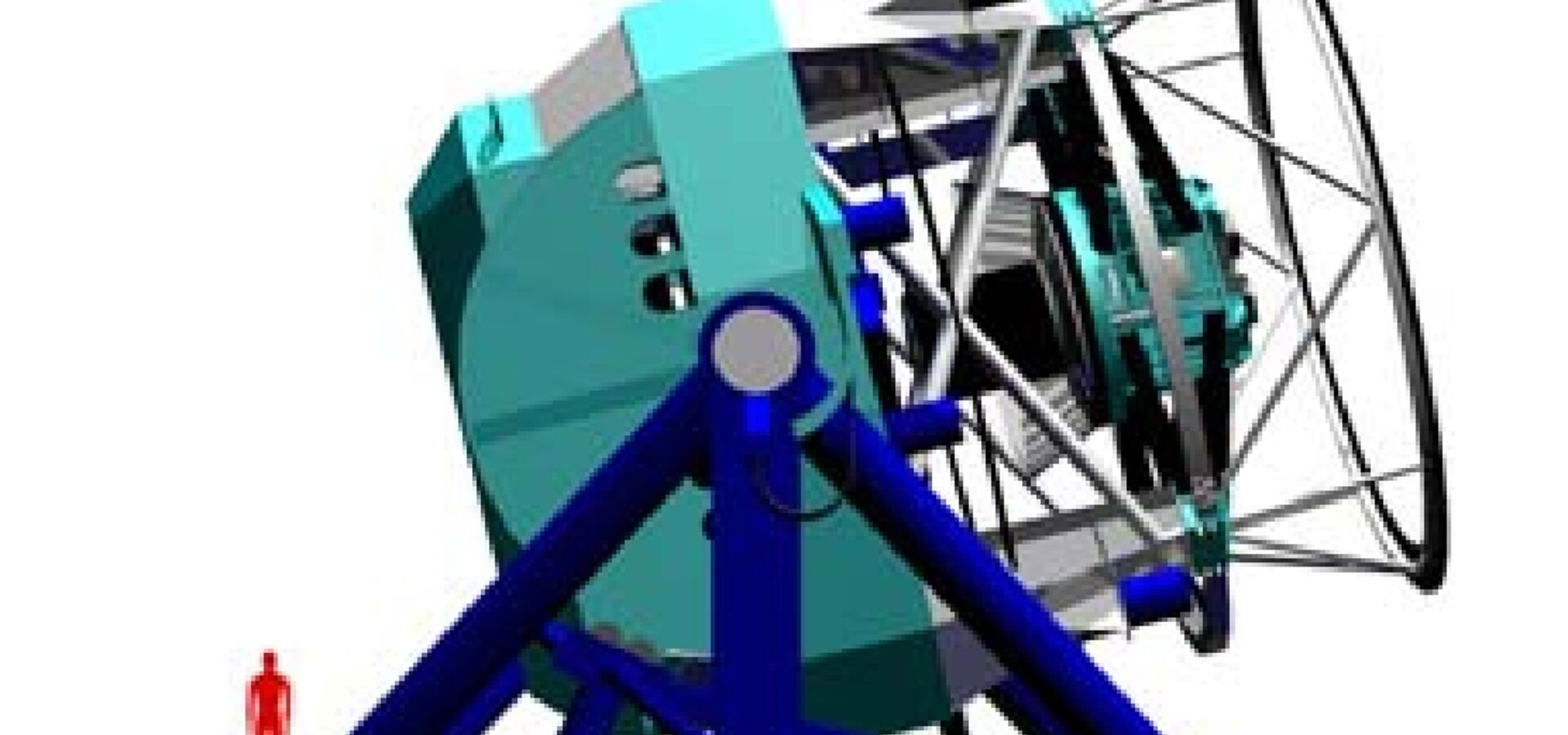
Sideview of the 8.4-meter LSST

Media

Sideview of the 8.4-meter LSST

Related News Posts

Loading the News...
Go Back to News Posts

Large Synoptic Survey Telescope (LSST) receives $14.2 million National Science Foundation Design and Development Award

August 22, 2005
The Large Synoptic Survey Telescope (LSST) has been awarded a four-year, $14.2 million Cooperative Agreement with the National Science Foundation to design and develop a world-class, 8.4-meter telescope scheduled for completion in 2012.

This award will allow engineers and scientists to complete design work already underway so that the LSST can begin construction in 2009. This unique system for surveying the heavens is made possible by advances in several technologies including:

  • Large optics fabrication to create the telescope’s distinctive 3- mirror design which includes a convex 4-meter secondary mirror, the size of many primary mirrors on today’s large research telescopes.
  • Data management systems to process and catalog the 30 terabytes of data generated nightly, the equivalent of 7,000 DVDs.
  • New detectors needed to build the LSST’s 3 billion pixel digital camera, the largest ever created.

The LSST will image an area of the sky roughly fifty times that of the full moon every 15 seconds, opening a movie-like window on objects that change or move on rapid time scales – supernovae explosions which can be seen halfway across the universe, nearby asteroids which might potentially strike Earth, and faint objects in the outer solar system, far beyond Pluto. Using the light-bending gravity of dark matter, the LSST will chart the history of the expansion of the universe and probe the mysterious nature of dark energy.

The LSST data will be “open” to the public and scientists around the world – anyone with a web browser will be able to access the images and other data produced by the LSST. “The LSST is a public-private partnership and will offer a 'New Sky' available to everyone," said LSST Director J. Anthony Tyson of the University of California, Davis. "Curious minds of all ages will be able to ask new questions of the LSST’s public database and zoom into a color movie of the deep universe.”

The LSST Corporation awarded a $2.3 million contract to the University of Arizona Steward Observatory Mirror Lab in January, 2005, to purchase the glass and begin engineering work for the LSST’s 8.4-meter diameter main mirror. Although the final site for the LSST has not been decided, the telescope will be placed in one of three candidate locations -- Las Campanas, Chile; Cerro Pachon, Chile; or San Pedro Martir, Baja California, Mexico.

More Information

The LSST has been identified as a national scientific priority in reports by several National Academy of Sciences and federal agency advisory committees. This judgment is based upon the LSST's ability to address some of the most pressing open questions in astronomy and fundamental physics, while driving advances in data-intensive science and computing. The National Academy of Sciences “Quarks - to Cosmos” report recommended the LSST as an incisive probe of the nature of dark energy. The LSST will open a new frontier in addressing time variable phenomena in astronomy, according to a May 2000 academy report “Astronomy and Astrophysics in the New Millennium.”

In 2003, the University of Arizona, the National Optical Astronomy Observatory, Research Corporation, and the University of Washington, formed the LSST Corporation, a non-profit 501(c)3 Arizona corporation, with headquarters in Tucson, AZ. Membership has expanded to include Brookhaven National Laboratory, Harvard-Smithsonian Center for Astrophysics, Johns Hopkins University, Lawrence Livermore National Laboratory, Stanford Linear Accelerator Center, Stanford University, University of California at Davis, and the University of Illinois at Urbana-Champaign.

Learn more about this release on NOIRLab.edu

Links

Contacts

  • J. Anthony Tyson
    LSST Director
    530-752-3830530-752-3830
    tyson@lsst.org
  • Donald Sweeney
    LSST Project Manager
    520-881-2626520-881-2626
    sweeney@lsst.org
  • Suzanne Jacoby
    LSST Corporation
    520-881-2626520-881-2626
    sjacoby@lsst.org