Localize site content
    • About
    • History
    • Who was Vera Rubin?
      • Rubin in Chile
      • Cerro Pachón
      • Observatory Site Selection
      • Organization
      • Leadership
      • Science Collaborations
      • Departments and Teams
    • Funding Information
      • Work With Us
      • Jobs Board
    • Explore
    • Rubin Basics
      • How Rubin Works
      • Legacy Survey of Space and Time (LSST)
      • Rubin Technology
      • Alert Stream
      • Rubin Numbers
    • Science Goals
      • Skyviewer ↗
      • Skysynth: The cosmos captured by Rubin, for your ears
    • Orbitviewer ↗
    • Rubin Voices
    • Get Involved in Rubin Research
      • Activities, Games, and More
      • Space Surveyors Game
      • Animated Video Series
      • Rubin's 3200-Megapixel Group Photo
    • Gallery
      • Main Gallery
      • Featured Media
      • First Look
      • Graphics & Illustrations
      • Outreach & Education
    • Slideshows
    • Construction Archive Gallery
    • Media Use Policy
    • News
    • Press Releases
      • Rubin Observatory First Look
      • The Cosmic Treasure Chest
      • A Swarm of New Asteroids
      • Rhythms in the Stars
      • Trifid and Lagoon Nebulae
      • Rubin First Look Watch Parties
    • Media Resources
    • Press Releases
    • Name Guidelines
    • For Scientists
    • Get started
      • News, events, and deadlines
      • Rubin Science Assemblies
      • Rubin Data Academy
      • Rubin Community Workshop
      • Resources for scientists
      • Rubin Community Forum
      • Early Science Program
      • Workshops and seminars
      • Tutorials
      • LSST Discovery Alliance
      • Public outreach materials
      • For amateur astronomers
      • Survey, instruments, and telescopes
      • Key numbers
      • The Legacy Survey of Space and Time (LSST)
      • Instruments
      • Telescopes
      • Data products, pipelines, and services
      • Data Policy
      • Data access and analysis
      • Recent data releases
      • Alerts and brokers
      • Data processing pipelines
      • User-contributed resources
      • Future data products
      • Simulation software
      • Documentation and publications
      • Technical documentation
      • How to cite Rubin Observatory
      • Publication policies
      • Glossary & Acronyms
      • Papers citing Rubin Observatory
      • Science Collaborations
      • Galaxies Science Collaboration
      • Stars, Milky Way, and Local Volume Science Collaboration
      • Solar System Science Collaboration
      • Dark Energy Science Collaboration
      • Active Galactic Nuclei Science Collaboration
      • Transients and Variable Stars Science Collaboration
      • Strong Lensing Science Collaboration
      • Informatics and Statistics Science Collaboration
    • Citizen Science
      • Committees and teams
      • Science Advisory Committee (SAC)
      • Survey Cadence Optimization Committee (SCOC)
      • Users Committee
      • Target of Opportunity (ToO) Advisory Board
      • Resource Allocation Committee (RAC)
      • Community Science Team (CST)
      • Research Inclusion Working Group (RIWG)
      • Project Science Team (PST)
      • In Kind Program
      • Resources
      • In-Kind Program FAQs
      • Frequently Asked Questions
      • How to navigate this website
      • Code of Conduct
      • Interim CoC
    • Education
    • First Look Resources for Lasting Impact
    • Education FAQs
    • Educators
    • Glossary
    • Investigations
    • Calendar
Localize site content
  • Contact Us
  • Jobs Board
  • Intranet
  • Visual Identity Guide
  • Privacy Policy

The U.S. National Science Foundation (NSF) and the U.S. Department of Energy (DOE) Office of Science will support Rubin Observatory in its operations phase to carry out the Legacy Survey of Space and Time. They will also provide support for scientific research with the data. During operations, NSF funding is managed by the Association of Universities for Research in Astronomy (AURA) under a cooperative agreement with NSF, and DOE funding is managed by SLAC National Accelerator Laboratory (SLAC), under contract by DOE. Rubin Observatory is operated by NSF NOIRLab and SLAC.

NSF is an independent federal agency created by Congress in 1950 to promote the progress of science. NSF supports basic research and people to create knowledge that transforms the future.

The DOE Office of Science is the single largest supporter of basic research in the physical sciences in the United States and is working to address some of the most pressing challenges of our time.

Funding agency logos
Homepage

Let's Connect

  • Visit the Rubin Observatory on Facebook
  • Visit the Rubin Observatory on Instagram
  • Visit the Rubin Observatory on LinkedIn
  • Visit the Rubin Observatory on Twitter
  • Visit the Rubin Observatory on YouTube
    1. News
    2. Rubin's 8.4-meter Mirror Reaches the Summit

    Media

    Tags

    • #Tucson

    Related News Posts

    Loading the News...
    Go Back to News Posts

    Rubin's 8.4-meter Mirror Reaches the Summit

    May 10, 2018
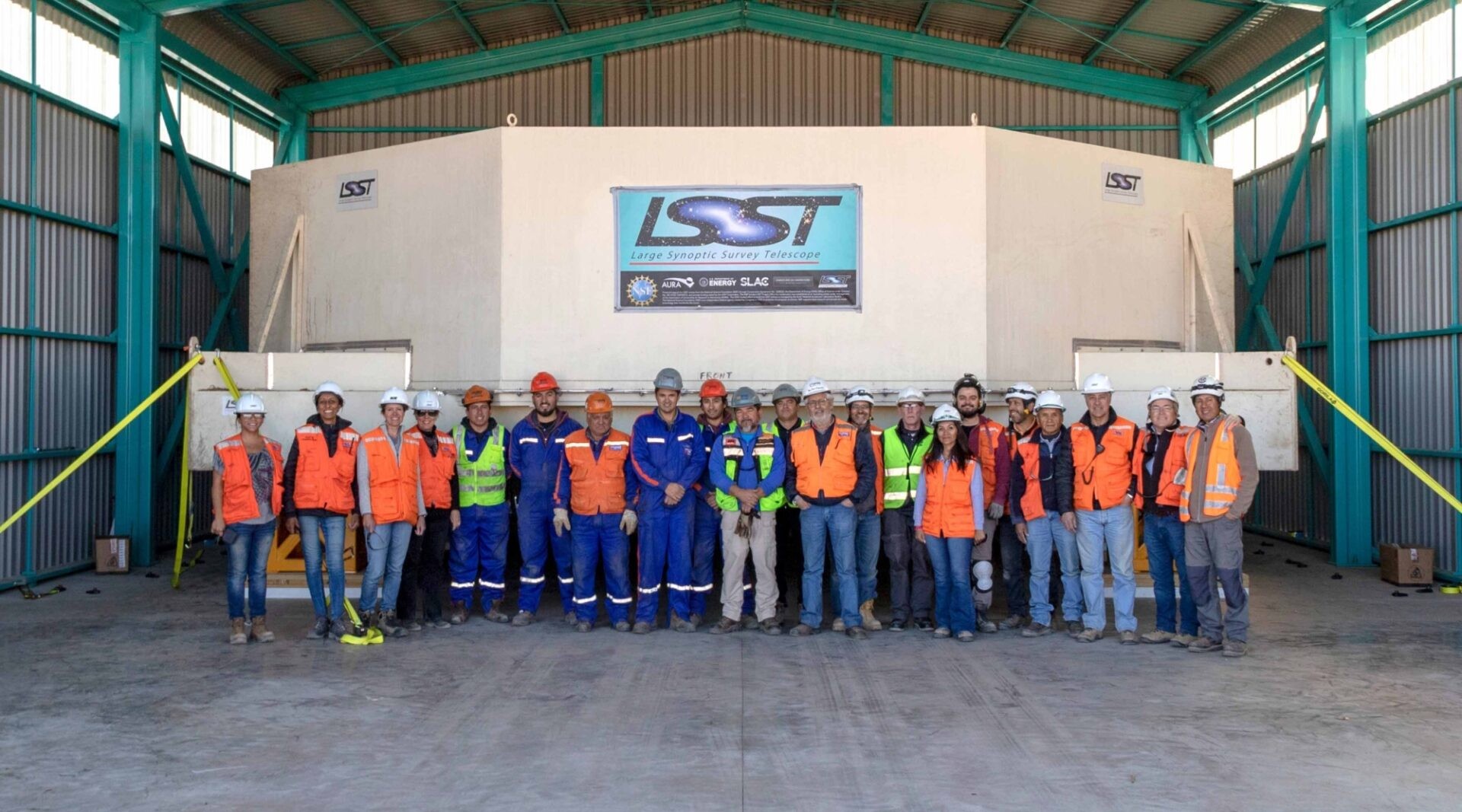
    This morning, a unique astronomical mirror reached its new home in the Andes Mountains of Northern Chile. This incredible mirror will enable the Large Synoptic Survey Telescope (LSST) to catalog an estimated ~40 billion celestial objects—more objects than there are humans on earth. LSST will scan the entire visible sky every few nights, visiting each location approximately ~1000 times during its ten-year survey, which is scheduled to begin in 2022. With these fast, repeated observations LSST will open a new window to the changing Universe, providing countless new opportunities to do science with transient objects such as asteroids and supernovae. Additionally, with the wide field of view made possible by this mirror, LSST will advance the study of dark matter and dark energy. The 8.4-meter LSST Primary/Tertiary Mirror (M1M3), one of the largest and most recognizable elements of the telescope, is unusual because it consists of two mirror surfaces combined on one large substrate. Light from the sky will hit the outer ring (M1) first, reflect upwards to a separate second mirror (M2), and then bounce back down to the inner ring (M3) of the monolith before reaching the telescope. LSST's three-mirror design, combined with a highly sensitive camera, allows the telescope to collect light from faint objects over a very large field of view. Combining the M1 and M3 mirrors gives the telescope a more compact shape, which enables it to move (slew) quickly between points on the sky and to settle efficiently before taking its next image. The M1M3 safely arrived at the LSST summit facility building on Cerro Pachón in Chile on May 11, 2019. Its eight-week journey began on March 15, in Tucson, Arizona, USA, where it was fabricated. The M1M3 was the first LSST component to be completed, and the mirror will play a critical role in enabling countless scientific discoveries.

    This morning, a unique astronomical mirror reached its new home in the Andes Mountains of Northern Chile. This incredible mirror will enable Rubin Observatory to catalog an estimated ~40 billion celestial objects—more objects than there are humans on earth. Rubin Observatory will scan the entire visible sky every few nights, visiting each location approximately ~1000 times during its ten-year survey, which is scheduled to begin in 2024. With these fast, repeated observations, Rubin will provide countless new opportunities to do science with transient objects such as asteroids and supernovae. Additionally, with the wide field of view made possible by this mirror, Rubin Observatory will advance the study of dark matter and dark energy.

    The 8.4-meter LSST Primary/Tertiary Mirror, one of the largest and most recognizable elements of the telescope, is unusual because it consists of two mirror surfaces combined on one large substrate. Light from the sky will hit the outer ring first, reflect upwards to a separate second mirror, and then bounce back down to the inner ring of the monolith before reaching the telescope. Rubin Observatory's three-mirror design, combined with its highly sensitive camera, allows the telescope to collect light from faint objects over a very large field of view. Combining the primary and tertiary mirrors gives the telescope a more compact shape, which enables it to move (slew) quickly between points on the sky and to settle efficiently before taking its next image.

    The 8.4-meter mirror safely arrived at the Rubin Observatory facility on Cerro Pachón in Chile on May 11, 2019. Its eight-week journey began on March 15, 2019, in Tucson, Arizona, USA, where it was fabricated. This mirror was the first Rubin Observatory component to be completed, and it will play a critical role in enabling countless scientific discoveries.