
Impacts from artificial satellites and debris
Date last updated: 22 Jul 2026 11:40 (MST)
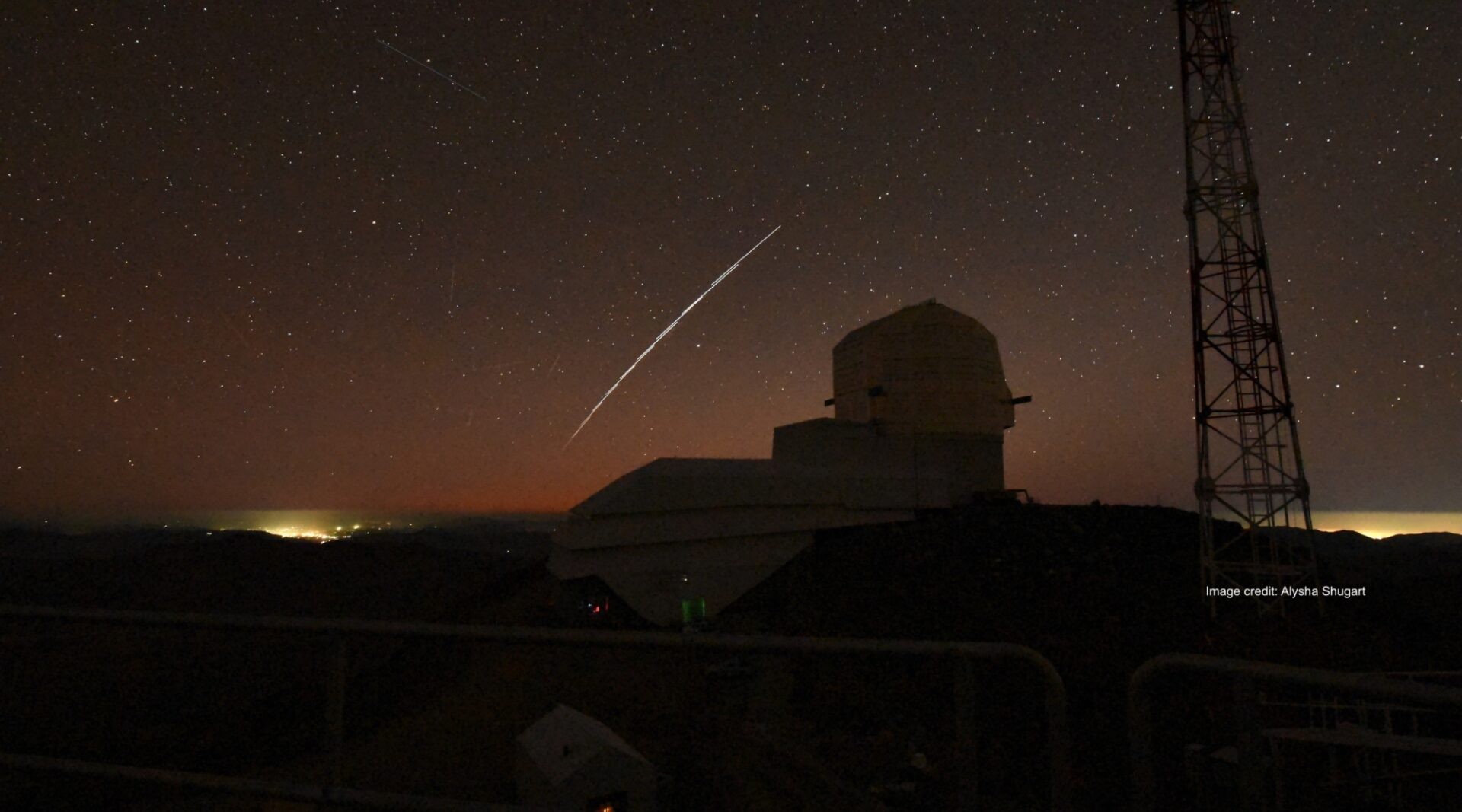
Low-Earth orbit (LEO) satellites pose a real challenge to the Rubin Observatory and its LSST. The satellites appear as bright streaks in astronomical images, rendering the underlying sources undetectable. While great science will still be done with the LSST, it is particularly vulnerable to systematic errors due to this kind of light pollution. Revolutionary discoveries could be significantly degraded, especially considering the scale of possible future satellite deployments.
The number of LEO satellites that reflect sunlight and contaminate astronomical images is rapidly increasing, as tracked on the Space Environment Statistics webpage. While there are currently several tens of thousands of tracked space objects, planned commercial satellites number well over one million objects. Even if only a fraction of these launch, some future satellites may be particularly large and bright (up to and sometimes even exceeding 0th apparent visual magnitude).

Impact on Rubin images
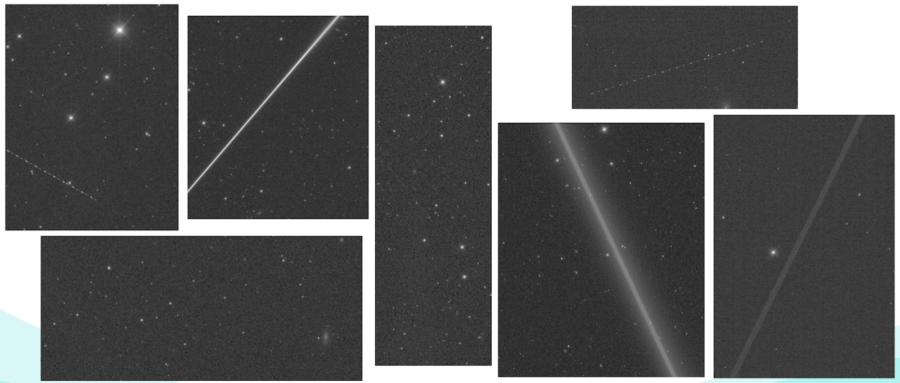
During a 30-second LSST visit an LEO satellite moves about 15 degrees, leaving a streak across the entire 3.5 degree field of view. Satellites and debris dimmer than 6th to 7th visual magnitude still cause streaks and glints, but typically leave the rest of the pixels scientifically usable. Brighter satellites can affect an entire LSST camera detector and render larger portions of an exposure useless.
LEO satellites are most numerous in fields close to the horizon a few hours after sunset and before sunrise. Simulations of the LSST observing cadence and 40,000 LEO satellites show that about 10% of all LSST images would contain at least one satellite trail, and the majority of images in twilight would contain streaks (Hu et al. 2022).
Small LEO debris with radii less than 10cm is expected to be sufficiently faint and out-of-focus as to not have a significant impact (Tyson et al. 2024), unless it is composed of mirror-like material that can produce bright glints, or glint trains if the debris is tumbling. The overall sky background is expected to increase over the 10-year LSST due to the proliferation of such small debris in LEO (Kocifaj et al. 2021), making faint-object detection and low surface brightness science investigations more challenging.
Impact on Rubin science
The presence of LEO satellite streaks in images impacts most LSST science goals. For example, the ability to detect hazardous asteroids approaching from a sunward direction will be disproportionately impacted, as those regions are only accessible during twilight. Precision cosmology results are sensitive to even small systematic effects that could be introduced by satellite streaks. And bogus alerts from glints or flares of maneuvering satellites (or tumbling debris), even if faint, might be impossible to eliminate. Work is ongoing to quantify these impacts, which depends strongly on the rapidly changing satellite population.
Mitigation strategies
Rubin scientists and colleagues are actively engaged with satellite operators, policymakers, regulatory groups, and industry professionals via the International Astronomical Union (IAU) Centre for the Protection of the Dark and Quiet Sky (CPS). The IAU CPS aims to coordinate efforts and unify voices across the global astronomical community; anyone can apply to join CPS and contribute to its mission.
… for satellite operators
The IAU CPS recommends that satellites should never be visible to the unaided eye, and the maximum allowed brightness should be apparent V magnitude no brighter than 7 for satellites with orbits ≤ 550 km altitude (see Box 1 of the CPS Recommendations Paper and also Boley et al. 2025). Lower orbits are also typically better for LSST: the satellites move faster and are out of focus, and their streaks have a fainter surface brightness (Snyder and Tyson, 2025).
Many commercial satellite operators are working to voluntarily mitigate the impacts on ground-based astronomy and sky observers worldwide by, e.g., painting, baffling, or rotating the satellites. However, there are no regulatory limits on satellite emissions or reflectivity outside the radio spectrum, and most commercial LEO satellites do not consistently meet the recommended brightness thresholds (Mallama and Cole, 2025). Several operators have entered into coordination agreements with the NSF (e.g., AST SpaceMobile and Amazon’s Project Kuiper), which is one mechanism for encouraging best practices in space sustainability and darkening mitigations.
… for Rubin data processing
Streak detection is implemented in the Rubin data processing pipelines, and occurs in two main portions of the pipeline. First, pixels associated with detected streaks are identified in the image mask plane and excluded from contributing to the deep coadded images. Second, sources identified in regions associated with streaks or glint trains are flagged during image subtraction and not used to create new difference imaging objects. In addition, alerts are only sent for detected difference-image sources that do not coincide with known satellite sky locations.
While it cannot be guaranteed that the LSST data products will be free of contamination from artificial satellites and debris, active efforts are ongoing to identify and label (or remove) them, and provide guidance for scientific analysis. No pixels are redacted, and work is underway to quantify systematic errors from streaks that fall below the detection thresholds as well as impacts from bright streaks that overwhelm large portions of detectors.
… for the Rubin scheduler
Options for strategies to adjust the LSST Scheduler algorithm to avoid sky regions with many known satellites, avoid ultra-bright satellites specifically, or request certain satellite operators adjust the attitude so their hardware appears dimmer, are currently under investigation (e.g., Hu et al. 2022, Nhan et al. 2024).
… for scientists
Signatures from satellites may appear in LSST data products despite the Rubin Data Management team’s best efforts. Difference imaging catalogs have some flag columns which are designed to indicate sources that may be affected by streaks or glints (e.g., look for columns with “streak” or “glint” in their name). The IAU CPS SatHub has developed NOIRLab-hosted tools that may be useful for scientists working with Rubin data products. One of these is SatChecker, satchecker.readthedocs.io, a tool for identifying possible streak and glint origins from the public satellite catalog. Work is ongoing to improve and refine this service, as well as to develop standard techniques for measuring the brightness of streaks and glints and measuring their impact on scientific investigations. The IAU CPS SatHub further solicits contributions to its Satellite Constellation Observation Repository (SCORE, score.cps.iau.org) from the community. Anyone interested to contribute to these or related research projects is encouraged to join SatHub by visiting cps.iau.org.
Resources
Phanindra et al. (2025): Report on LEO satellite impacts on ground-based optical astronomy for the Rubin Observatory LSST
Boley et al. (2025): IAU CPS Satellite Optical Brightness Recommendation: Rationale
Mallama and Cole (2025): Satellite constellations exceed the limits of acceptable brightness established by the IAU
Snyder and Tyson (2025): Satellite Streak Brightness Variation with Orbit Height
CPS Recommendations Paper (2024): Call to Protect the Dark and Quiet Sky from Harmful Interference by Satellite Constellations
Nhan et al. (2024): Toward Spectrum Coexistence: First Demonstration of the Effectiveness of Boresight Avoidance between the NRAO Green Bank Telescope and Starlink Satellites
Peel et al. (2024): Summary of SatHub, and the current observational status of satellite constellations
Tyson et al. (2024): Expected Impact of Glints from Space Debris in the LSST
Hu et al. (2022): Satellite Constellation Avoidance with the Rubin Observatory Legacy Survey of Space and Time
Hall et al. (2021): SATCON2 (Satellite Constellations 2): Executive Summary
Rawls et al. (2021): SATCON2: Observations Working Group Report
Kocifaj et al. (2021): The proliferation of space objects is a rapidly increasing source of artificial night sky brightness
Tyson et al. (2020): Mitigation of LEO Satellite Brightness and Trail Effects on the Rubin Observatory LSST
Rubin Community Forum
Ask questions, get help, report bugs or errors, and join in discussions about Rubin Observatory and its data products, pipelines, and services.