Homepage
Localize site content
    • About
    • History
    • Who was Vera Rubin?
      • Rubin in Chile
      • Cerro Pachón
      • Observatory Site Selection
      • Organization
      • Leadership
      • Science Collaborations
      • Departments and Teams
    • Funding Information
      • Work With Us
      • Jobs Board
    • Explore
      • How Rubin Works
      • Legacy Survey of Space and Time (LSST)
      • Rubin Technology
      • Alert Stream
      • Rubin Numbers
    • Science Goals
      • Skyviewer ↗
      • Skysynth: The cosmos captured by Rubin, for your ears
    • Orbitviewer ↗
    • Rubin Voices
    • Get Involved in Rubin Research
      • Activities, Games, and More
      • Space Surveyors Game
      • Animated Video Series
      • Rubin's 3200-Megapixel Group Photo
    • Gallery
      • Main Gallery
      • First Look
      • Graphics & Illustrations
      • Outreach & Education
    • Slideshows
    • Construction Archive Gallery
    • Media Use Policy
    • News
    • Press Releases
      • Rubin Observatory First Look
      • The Cosmic Treasure Chest
      • A Swarm of New Asteroids
      • Rhythms in the Stars
      • Trifid and Lagoon Nebulae
      • Rubin First Look Watch Parties
    • Media Resources
    • Press Releases
    • Name Guidelines
    • For Scientists
      • News, events, and deadlines
      • Rubin Science Assemblies
      • Rubin Data Academy
      • Rubin Community Workshop
      • Resources for scientists
      • Rubin Community Forum
      • Early Science Program
      • Workshops and seminars
      • Tutorials
      • LSST Discovery Alliance
      • Code of Conduct
      • Public outreach materials
      • Survey, instruments, and telescopes
      • Key numbers
      • The Legacy Survey of Space and Time (LSST)
      • Instruments
      • Telescopes
      • Data products, pipelines, and services
      • Data access and analysis
      • Recent data releases
      • Alerts and brokers
      • Data processing pipelines
      • Future data products
      • Data Policy
      • Simulation software
      • Documentation and publications
      • Technical documentation
      • How to cite Rubin Observatory
      • Publication policies
      • Glossary & Acronyms
      • Papers citing Rubin Observatory
      • Science Collaborations
      • Galaxies Science Collaboration
      • Stars, Milky Way, and Local Volume Science Collaboration
      • Solar System Science Collaboration
      • Dark Energy Science Collaboration
      • Active Galactic Nuclei Science Collaboration
      • Transients and Variable Stars Science Collaboration
      • Strong Lensing Science Collaboration
      • Informatics and Statistics Science Collaboration
    • Citizen Science
      • Committees and teams
      • Science Advisory Committee (SAC)
      • Survey Cadence Optimization Committee (SCOC)
      • Users Committee
      • Target of Opportunity (ToO) Advisory Board
      • Community Science Team (CST)
      • Research Inclusion Working Group (RIWG)
      • Project Science Team (PST)
      • In Kind Program
      • Resources
      • In-Kind Program FAQs
      • Frequently Asked Questions
      • How to navigate this website
    • Education
    • First Look Resources for Lasting Impact
    • Education FAQs
    • Educators
    • Glossary
    • Investigations
    • Calendar
Localize site content

Let's Connect

  • Contact Us
  • Jobs Board
  • Intranet
  • Visual Identity Guide
  • Privacy Policy

The U.S. National Science Foundation (NSF) and the U.S. Department of Energy (DOE) Office of Science will support Rubin Observatory in its operations phase to carry out the Legacy Survey of Space and Time. They will also provide support for scientific research with the data. During operations, NSF funding is managed by the Association of Universities for Research in Astronomy (AURA) under a cooperative agreement with NSF, and DOE funding is managed by SLAC National Accelerator Laboratory (SLAC), under contract by DOE. Rubin Observatory is operated by NSF NOIRLab and SLAC.

NSF is an independent federal agency created by Congress in 1950 to promote the progress of science. NSF supports basic research and people to create knowledge that transforms the future.

The DOE Office of Science is the single largest supporter of basic research in the physical sciences in the United States and is working to address some of the most pressing challenges of our time.

Funding agency logos
  • Visit the Rubin Observatory on Facebook
  • Visit the Rubin Observatory on Instagram
  • Visit the Rubin Observatory on LinkedIn
  • Visit the Rubin Observatory on Twitter
  • Visit the Rubin Observatory on YouTube
    1. News
    2. Host a Rubin First Look Watch Party
    Host a Rubin First Look Watch Party

    Media

    Host a Rubin First Look Watch Party
    Host a Rubin First Look Watch Party

    Tags

    • #Rubin First Look

    Related News Posts

    Loading the News...
    Go Back to News Posts

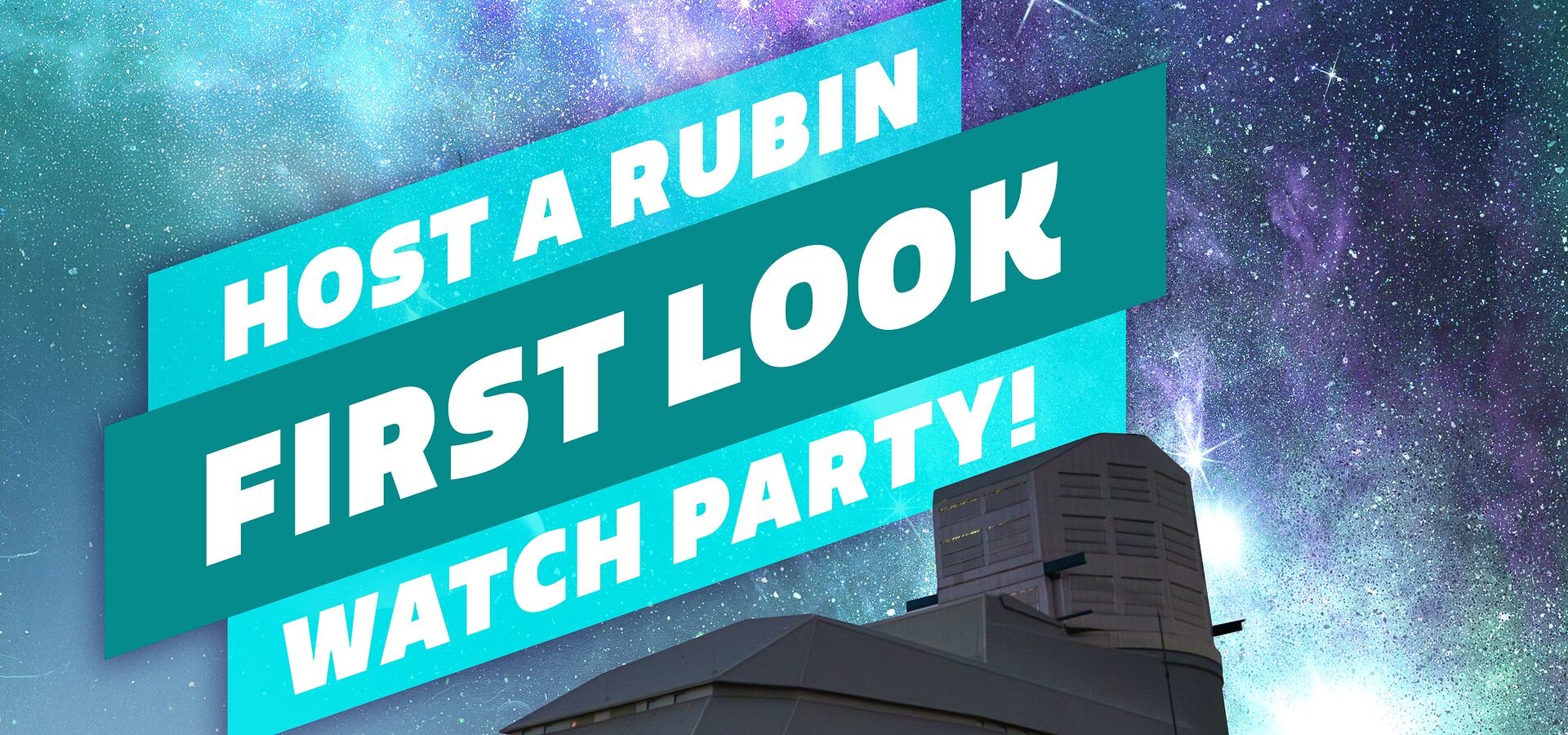
    Host a Rubin First Look Watch Party

    Join the global celebration of NSF–DOE Vera C. Rubin Observatory’s First Look images
    April 24, 2025

    The NSF–DOE Vera C. Rubin Observatory and its partners are excited be announcing the release of the first images at the First Look unveiling event June 23 at 11:00 am EDT with a public livestream (in English and Spanish).

    During the First Look event, the comprehensive press release will be published, featuring a large set of ultra-high-definition images and videos showcasing Rubin’s extraordinary capabilities to the world for the first time. This will mark the beginning of a new era in astronomy, and we invite you to take part (sign up using this form).

    NSF–DOE Vera C. Rubin Observatory is jointly funded by the U.S. National Science Foundation (NSF) and the U.S. Department of Energy’s Office of Science (DOE/SC). Rubin Observatory is a joint Program of NSF NOIRLab and SLAC National Accelerator Laboratory (SLAC), who will cooperatively operate Rubin.

    Rubin First Look Watch Parties are expected to take place around the world at universities, planetariums, museums, libraries, cinemas, and more. To witness the reveal of the first Rubin images, Rubin First Look Watch Parties may stream the live unveiling event. A simultaneous live stream of the First Look Watch Party in Santiago, Chile will be available in Spanish. Local adaptations are encouraged and may include holding the event in the local language; inviting scientists, dignitaries, or media; and additional programming like planetarium shows, photo exhibitions, guided tours, star parties, hands-on activities, or talks. The sky's the limit!

    Those who sign up to host a Watch Party will be sent a curated list of materials they can use to organize a viewing event at their venue. Material packages include interactive resources like a virtual tour of Cerro Pachón and a virtual 3D model of the observatory. They will also include state-of-the-art planetarium content, from fulldome images and videos to the new free planetarium show Messengers of Time and Space. A live domecast of the event is available for planetariums, hosted by the U.S. Space & Rocket Center’s INTUITIVE Planetarium. The Cosm-Rubin Digistar planetarium package is available for Digistar domes.

    Watch Party venues will not need to download extra software to view the First Look content. Images and videos will be accessible on rubinobservatory.org, as well as partner websites.

    Rubin Observatory will revolutionize how we explore the cosmos. Rubin will create the ultimate movie of the night sky using the largest camera ever built. This unique movie will bring the cosmos to life, yielding a treasure trove of discoveries: asteroids and comets, pulsating stars, and supernova explosions. With Rubin data, we will better understand the Universe, chronicle its evolution, delve into the mysteries of dark energy and dark matter, and reveal answers to questions we have yet to imagine. Sign up using this form to host a Rubin First Look Watch Party and join our global celebration.

    More Information

    Learn more about this release on NOIRLab.edu

    Links

    • Rubin First Look Watch Party website
    • Watch Party Sign-up Form
    • Rubin Observatory Media Kit
    • Vera C. Rubin Observatory website
    • Vera C. Rubin Observatory images
    • More Rubin images
    • Rubin videos
    • Rubin multimedia resources

    Contacts

    Phoebe Dubisch
    Rubin Watch Party Coordinator
    NSF NOIRLab
    Email: rubinparty@noirlab.edu 

    Josie Fenske
    Jr. Public Information Officer
    NSF NOIRLab
    Email: josie.fenske@noirlab.edu

    Gaëlle Shifrin-Suter
    Rubin First Look Coordinator
    SLAC
    Email: gsuter@slac.stanford.edu

    Lars Lindberg Christensen
    Head of Communications, Education & Engagement
    NSF NOIRLab
    Email: lars.christensen@noirlab.edu