
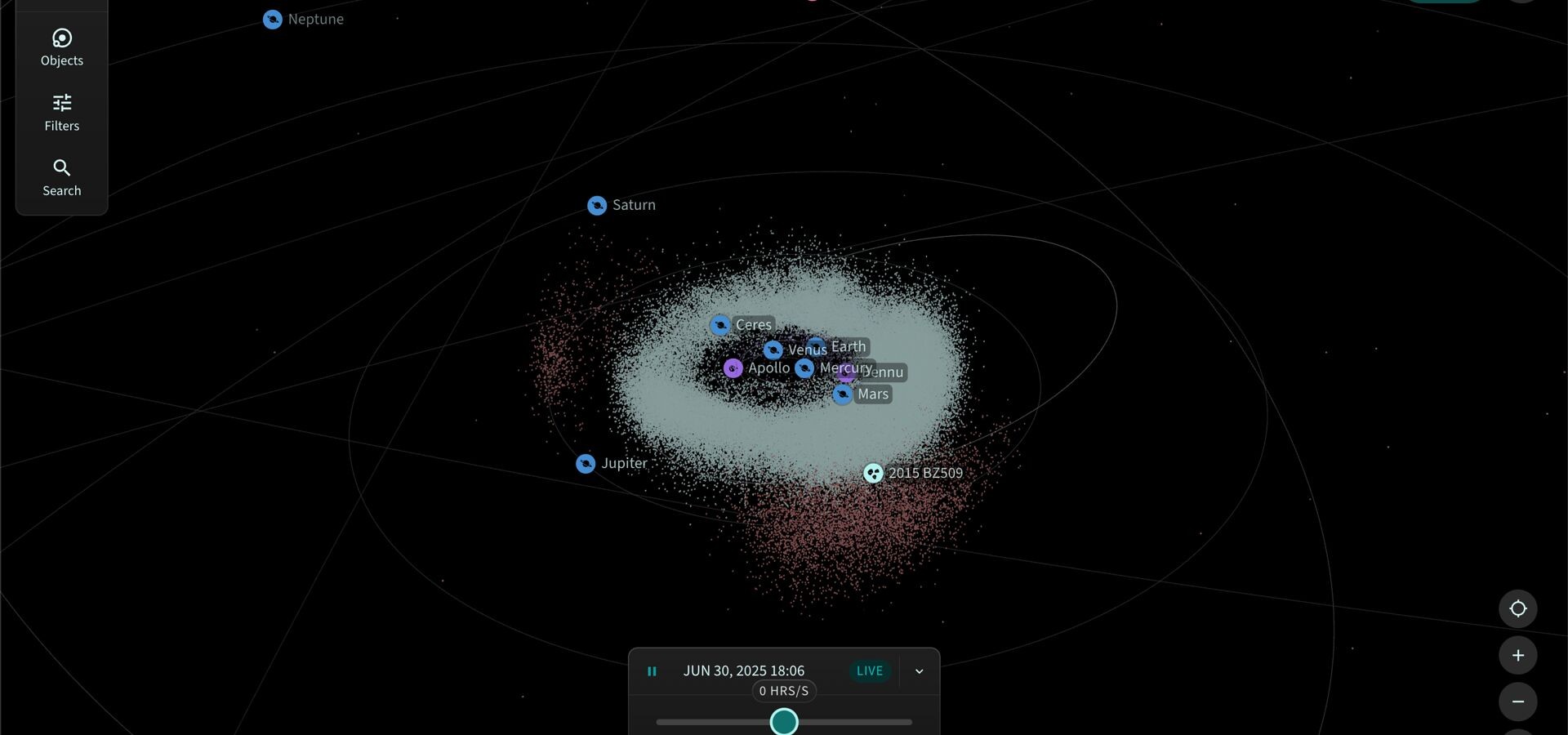
NSF–DOE Vera C. Rubin Observatory Launches Orbitviewer App
NSF–DOE Vera C. Rubin Observatory is thrilled to introduce Orbitviewer, a groundbreaking new web app that brings the dynamic movement of objects in our Solar System to life. Using real data from Rubin Observatory analyzed by the Minor Planet Center, Orbitviewer provides an unprecedented way to explore the structure of our cosmic backyard in three dimensions and in real time.
Rubin Observatory is jointly funded by the U.S. National Science Foundation and the U.S. Department of Energy’s Office of Science. Rubin is a joint Program of NSF NOIRLab and DOE’s SLAC National Accelerator Laboratory, who will cooperatively operate Rubin.
Orbitviewer is designed to showcase the incredible number of Solar System objects revealed by Rubin Observatory. In its first year, Rubin is expected to reveal more objects in our Solar System than have been discovered in the past 150 years combined. As Rubin Observatory embarks on its decade-long Legacy Survey of Space and Time (LSST), Orbitviewer will serve as a key tool for exploring and contextualizing millions of new discoveries. The in-app ‘discovery counter’ reflects Rubin Observatory’s ongoing discoveries, and will increase in real-time as new data comes in and more objects are identified.
Whether you're on a mobile phone, tablet, or desktop, Orbitviewer adapts to your device to ensure an optimal viewing experience. No downloads or installs are required — simply visit the website and you're ready to explore. You can customize your exploration by selecting from four different modes that range from 16,000 objects (optimized for mobile devices) to a high-performance set of one million objects (for powerful desktop machines).
With Orbitviewer, you’ll have access to detailed information about planets, dwarf planets, near-earth objects, main belt asteroids, trans-Neptunian objects, comets, interstellar objects, and much more. Learn about the overall structure of the Solar System by viewing the orbits of each category of object, or explore individual objects by clicking on their icons.
Orbitviewer was conceptualized and produced by Rubin Observatory’s Education and Public Outreach team, with design and development by Fil Studio, a digital studio based in Barcelona, Spain that specializes in crafting tailored interactive experiences. It offers several ways to interact with the Solar System’s data. You can rotate the view, zoom in on objects, adjust the time slider to move through the years 1900–2100, and apply filters to explore specific object types. Additionally, you can search for specific objects by name or designation and access detailed information on individual orbits.
While Orbitviewer is currently available in English, we’re pleased to announce that a Spanish version will be launching soon.
We invite you to dive into this exciting new tool and explore the Solar System like never before. Orbitviewer is here to revolutionize how we understand our cosmic neighborhood. Start exploring today!
More information
NSF–DOE Vera C. Rubin Observatory, funded by the U.S. National Science Foundation and the U.S. Department of Energy’s Office of Science, is a groundbreaking new astronomy and astrophysics observatory on Cerro Pachón in Chile. It is named after astronomer Vera Rubin, who provided the first convincing evidence for the existence of dark matter. Using the largest camera ever built, Rubin will repeatedly scan the sky for 10 years to create an ultra-wide, ultra-high-definition, time-lapse record of our Universe.
NSF–DOE Vera C. Rubin Observatory is a joint initiative of the U.S. National Science Foundation (NSF) and the U.S. Department of Energy’s Office of Science (DOE/SC). Its primary mission is to carry out the Legacy Survey of Space and Time, providing an unprecedented data set for scientific research supported by both agencies. Rubin is operated jointly by NSF NOIRLab and SLAC National Accelerator Laboratory. NSF NOIRLab is managed by the Association of Universities for Research in Astronomy (AURA) and SLAC is operated by Stanford University for the DOE. France provides key support to the construction and operations of Rubin Observatory through contributions from CNRS/IN2P3. Rubin Observatory is privileged to conduct research in Chile and gratefully acknowledges additional contributions from more than 40 international organizations and teams.
The U.S. National Science Foundation (NSF) is an independent federal agency created by Congress in 1950 to promote the progress of science. NSF supports basic research and people to create knowledge that transforms the future.
The DOE’s Office of Science is the single largest supporter of basic research in the physical sciences in the United States and is working to address some of the most pressing challenges of our time.
NSF NOIRLab, the U.S. National Science Foundation center for ground-based optical-infrared astronomy, operates the International Gemini Observatory (a facility of NSF, NRC–Canada, ANID–Chile, MCTIC–Brazil, MINCyT–Argentina, and KASI–Republic of Korea), NSF Kitt Peak National Observatory (KPNO), NSF Cerro Tololo Inter-American Observatory (CTIO), the Community Science and Data Center (CSDC), and NSF–DOE Vera C. Rubin Observatory (in cooperation with DOE’s SLAC National Accelerator Laboratory). It is managed by the Association of Universities for Research in Astronomy (AURA) under a cooperative agreement with NSF and is headquartered in Tucson, Arizona.
The scientific community is honored to have the opportunity to conduct astronomical research on I’oligam Du’ag (Kitt Peak) in Arizona, on Maunakea in Hawai‘i, and on Cerro Tololo and Cerro Pachón in Chile. We recognize and acknowledge the very significant cultural role and reverence of I’oligam Du’ag (Kitt Peak) to the Tohono O’odham Nation, and Maunakea to the Kanaka Maoli (Native Hawaiians) community.
SLAC National Accelerator Laboratory explores how the Universe works at the biggest, smallest and fastest scales and invents powerful tools used by researchers around the globe. As world leaders in ultrafast science and bold explorers of the physics of the Universe, we forge new ground in understanding our origins and building a healthier and more sustainable future. Our discovery and innovation help develop new materials and chemical processes and open unprecedented views of the cosmos and life’s most delicate machinery. Building on more than 60 years of visionary research, we help shape the future by advancing areas such as quantum technology, scientific computing and the development of next-generation accelerators. SLAC is operated by Stanford University for the U.S. Department of Energy’s Office of Science.
More Information
Learn more about this release on NOIRLab.eduContacts
Josie Fenske
Public Information Officer
NSF NOIRLab
Email: josie.fenske@noirlab.edu