
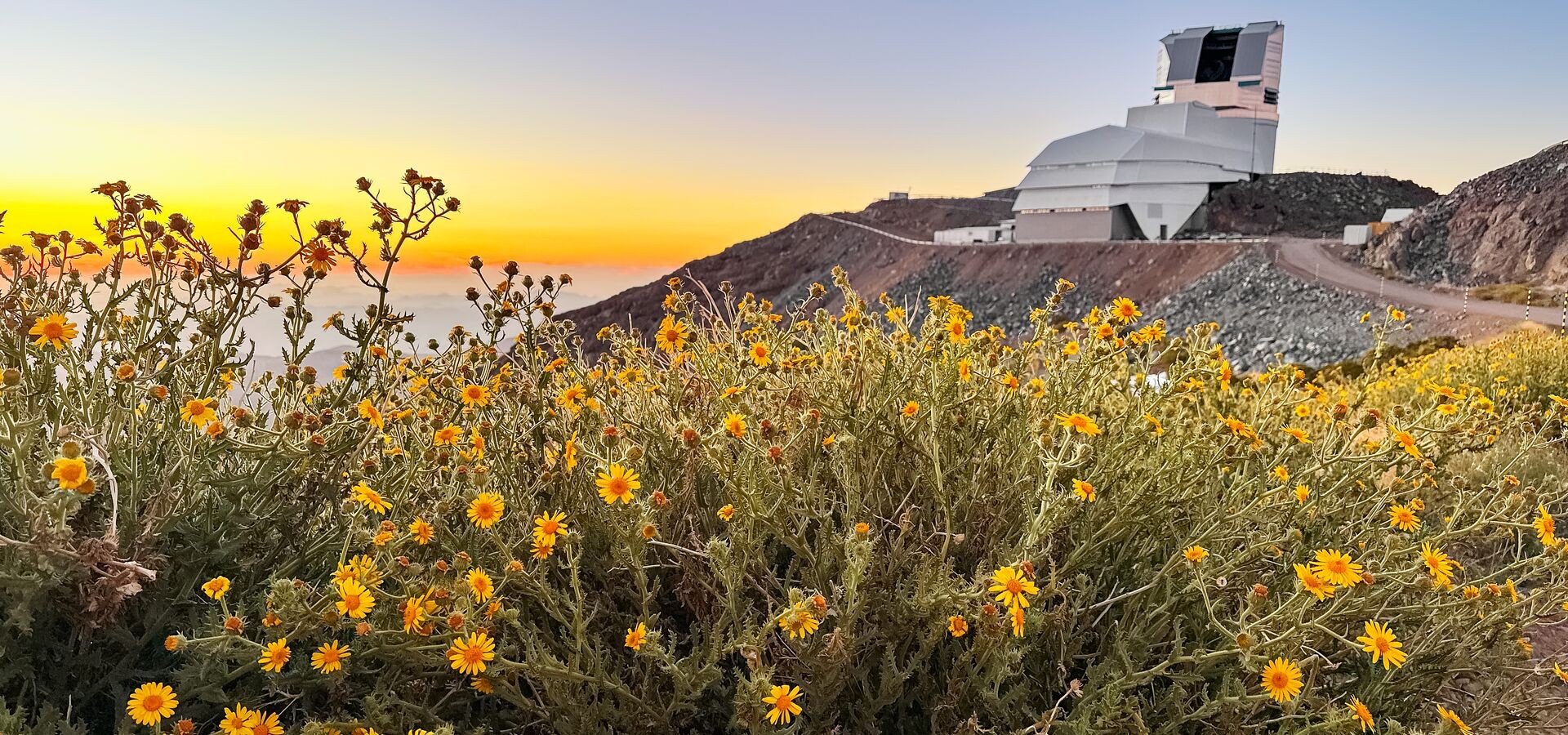
NSF–DOE Rubin Update for December 2025
It’s been a busy few months at NSF–DOE Vera C. Rubin Observatory, jointly funded by the U.S. National Science Foundation and the U.S. Department of Energy's Office of Science, since the release of the observatory’s first images to the world in June 2025.
Following Rubin Observatory’s hugely successful First Look event on 23 June 2025, Rubin scientists and engineers focused their full attention on commissioning activities, putting every part of the observatory system through careful testing to make sure it could deliver on Rubin’s ambitious science goals. The team also turned Rubin to the sky for a series of data-collecting runs to show that its survey capabilities were truly ready for prime time.
In September and October, the team put a pause on observing the sky to take care of some important tasks, including a few final “big lift” construction activities. One of these was lifting the last of three screen panels into the opening of the dome. This was a very delicate operation because the telescope’s optics were already installed, and they had to be carefully protected. These three panels, along with three more installed at the bottom of the aperture, will help shield the telescope from stray light and reduce wind shake during observations.
With the upper panels successfully placed — the last construction activity to require on-sky observing interruptions — Rubin had reached substantial completion of its construction phase and moved into its operations phase. The Rubin team gathered in Chile to mark the handover from construction to operations on 25 October 2025. But there was only a moment to celebrate the success of the decade-long construction project before getting back to work! The team brought Rubin back online the very next day and soon resumed observing the night sky.
Now, as we prepare to begin the 10-year Legacy Survey of Space and Time (LSST) in early 2026, Rubin’s team is busy fine-tuning the system: sharpening image quality, optimizing observing efficiency, and polishing every detail. Our goal is to make sure the whole observatory system is running at its best, so Rubin can start creating the greatest cosmic movie ever made.
More information
NSF–DOE Vera C. Rubin Observatory, funded by the U.S. National Science Foundation and the U.S. Department of Energy’s Office of Science, is a groundbreaking new astronomy and astrophysics observatory on Cerro Pachón in Chile. It is named after astronomer Vera Rubin, who provided the first convincing evidence for the existence of dark matter. Using the largest camera ever built, Rubin will repeatedly scan the sky for 10 years to create an ultra-wide, ultra-high-definition, time-lapse record of our Universe.
NSF–DOE Vera C. Rubin Observatory is a joint initiative of the U.S. National Science Foundation (NSF) and the U.S. Department of Energy’s Office of Science (DOE/SC). Its primary mission is to carry out the Legacy Survey of Space and Time, providing an unprecedented data set for scientific research supported by both agencies. Rubin is operated jointly by NSF NOIRLab and SLAC National Accelerator Laboratory. NSF NOIRLab is managed by the Association of Universities for Research in Astronomy (AURA) and SLAC is operated by Stanford University for the DOE. France provides key support to the construction and operations of Rubin Observatory through contributions from CNRS/IN2P3. Rubin Observatory is privileged to conduct research in Chile and gratefully acknowledges additional contributions from more than 40 international organizations and teams.
The U.S. National Science Foundation (NSF) is an independent federal agency created by Congress in 1950 to promote the progress of science. NSF supports basic research and people to create knowledge that transforms the future.
The DOE’s Office of Science is the single largest supporter of basic research in the physical sciences in the United States and is working to address some of the most pressing challenges of our time.
NSF NOIRLab, the U.S. National Science Foundation center for ground-based optical-infrared astronomy, operates the International Gemini Observatory (a facility of NSF, NRC–Canada, ANID–Chile, MCTIC–Brazil, MINCyT–Argentina, and KASI–Republic of Korea), NSF Kitt Peak National Observatory (KPNO), NSF Cerro Tololo Inter-American Observatory (CTIO), the Community Science and Data Center (CSDC), and NSF–DOE Vera C. Rubin Observatory (in cooperation with DOE’s SLAC National Accelerator Laboratory). It is managed by the Association of Universities for Research in Astronomy (AURA) under a cooperative agreement with NSF and is headquartered in Tucson, Arizona.
The scientific community is honored to have the opportunity to conduct astronomical research on I’oligam Du’ag (Kitt Peak) in Arizona, on Maunakea in Hawai‘i, and on Cerro Tololo and Cerro Pachón in Chile. We recognize and acknowledge the very significant cultural role and reverence of I’oligam Du’ag (Kitt Peak) to the Tohono O’odham Nation, and Maunakea to the Kanaka Maoli (Native Hawaiians) community.
SLAC National Accelerator Laboratory explores how the Universe works at the biggest, smallest and fastest scales and invents powerful tools used by researchers around the globe. As world leaders in ultrafast science and bold explorers of the physics of the Universe, we forge new ground in understanding our origins and building a healthier and more sustainable future. Our discovery and innovation help develop new materials and chemical processes and open unprecedented views of the cosmos and life’s most delicate machinery. Building on more than 60 years of visionary research, we help shape the future by advancing areas such as quantum technology, scientific computing and the development of next-generation accelerators. SLAC is operated by Stanford University for the U.S. Department of Energy’s Office of Science.
More Information
Learn more about this release on NOIRLab.eduContacts
Josie Fenske
Public Information Officer
NSF NOIRLab
Email: josie.fenske@noirlab.edu