Homepage
Localize site content
    • About
    • History
    • Who was Vera Rubin?
      • Rubin in Chile
      • Cerro Pachón
      • Observatory Site Selection
      • Organization
      • Leadership
      • Science Collaborations
      • Departments and Teams
    • Funding Information
      • Work With Us
      • Jobs Board
    • Explore
      • How Rubin Works
      • Legacy Survey of Space and Time (LSST)
      • Rubin Technology
      • Alert Stream
      • Rubin Numbers
    • Science Goals
      • Skyviewer ↗
      • Skysynth: The cosmos captured by Rubin, for your ears
    • Orbitviewer ↗
    • Rubin Voices
    • Get Involved in Rubin Research
      • Activities, Games, and More
      • Space Surveyors Game
      • Animated Video Series
      • Rubin's 3200-Megapixel Group Photo
    • Gallery
      • Main Gallery
      • First Look
      • Graphics & Illustrations
      • Outreach & Education
    • Slideshows
    • Construction Archive Gallery
    • Media Use Policy
    • News
    • Press Releases
      • Rubin Observatory First Look
      • The Cosmic Treasure Chest
      • A Swarm of New Asteroids
      • Rhythms in the Stars
      • Trifid and Lagoon Nebulae
      • Rubin First Look Watch Parties
    • Media Resources
    • Press Releases
    • Name Guidelines
    • For Scientists
      • News, events, and deadlines
      • Rubin Science Assemblies
      • Rubin Data Academy
      • Rubin Community Workshop
      • Resources for scientists
      • Rubin Community Forum
      • Early Science Program
      • Workshops and seminars
      • Tutorials
      • LSST Discovery Alliance
      • Code of Conduct
      • Public outreach materials
      • Survey, instruments, and telescopes
      • Key numbers
      • The Legacy Survey of Space and Time (LSST)
      • Instruments
      • Telescopes
      • Data products, pipelines, and services
      • Data access and analysis
      • Recent data releases
      • Alerts and brokers
      • Data processing pipelines
      • Future data products
      • Data Policy
      • Simulation software
      • Documentation and publications
      • Technical documentation
      • How to cite Rubin Observatory
      • Publication policies
      • Glossary & Acronyms
      • Papers citing Rubin Observatory
      • Science Collaborations
      • Galaxies Science Collaboration
      • Stars, Milky Way, and Local Volume Science Collaboration
      • Solar System Science Collaboration
      • Dark Energy Science Collaboration
      • Active Galactic Nuclei Science Collaboration
      • Transients and Variable Stars Science Collaboration
      • Strong Lensing Science Collaboration
      • Informatics and Statistics Science Collaboration
    • Citizen Science
      • Committees and teams
      • Science Advisory Committee (SAC)
      • Survey Cadence Optimization Committee (SCOC)
      • Users Committee
      • Community Science Team (CST)
      • Research Inclusion Working Group (RIWG)
      • Project Science Team (PST)
      • In Kind Program
      • Resources
      • In-Kind Program FAQs
      • Frequently Asked Questions
      • How to navigate this website
    • Education
    • First Look Resources for Lasting Impact
    • Education FAQs
    • Educators
    • Glossary
    • Investigations
    • Calendar
Localize site content

Let's Connect

  • Visit the Rubin Observatory on Facebook
  • Visit the Rubin Observatory on Instagram
  • Visit the Rubin Observatory on LinkedIn
  • Visit the Rubin Observatory on Twitter
  • Visit the Rubin Observatory on YouTube
  • Contact Us
  • Jobs Board
  • Intranet
  • Visual Identity Guide
  • Privacy Policy

The U.S. National Science Foundation (NSF) and the U.S. Department of Energy (DOE) Office of Science will support Rubin Observatory in its operations phase to carry out the Legacy Survey of Space and Time. They will also provide support for scientific research with the data. During operations, NSF funding is managed by the Association of Universities for Research in Astronomy (AURA) under a cooperative agreement with NSF, and DOE funding is managed by SLAC National Accelerator Laboratory (SLAC), under contract by DOE. Rubin Observatory is operated by NSF NOIRLab and SLAC.

NSF is an independent federal agency created by Congress in 1950 to promote the progress of science. NSF supports basic research and people to create knowledge that transforms the future.

The DOE Office of Science is the single largest supporter of basic research in the physical sciences in the United States and is working to address some of the most pressing challenges of our time.

Funding agency logos
  1. News
  2. LSST Coating Chamber Arrives On Cerro Pachón
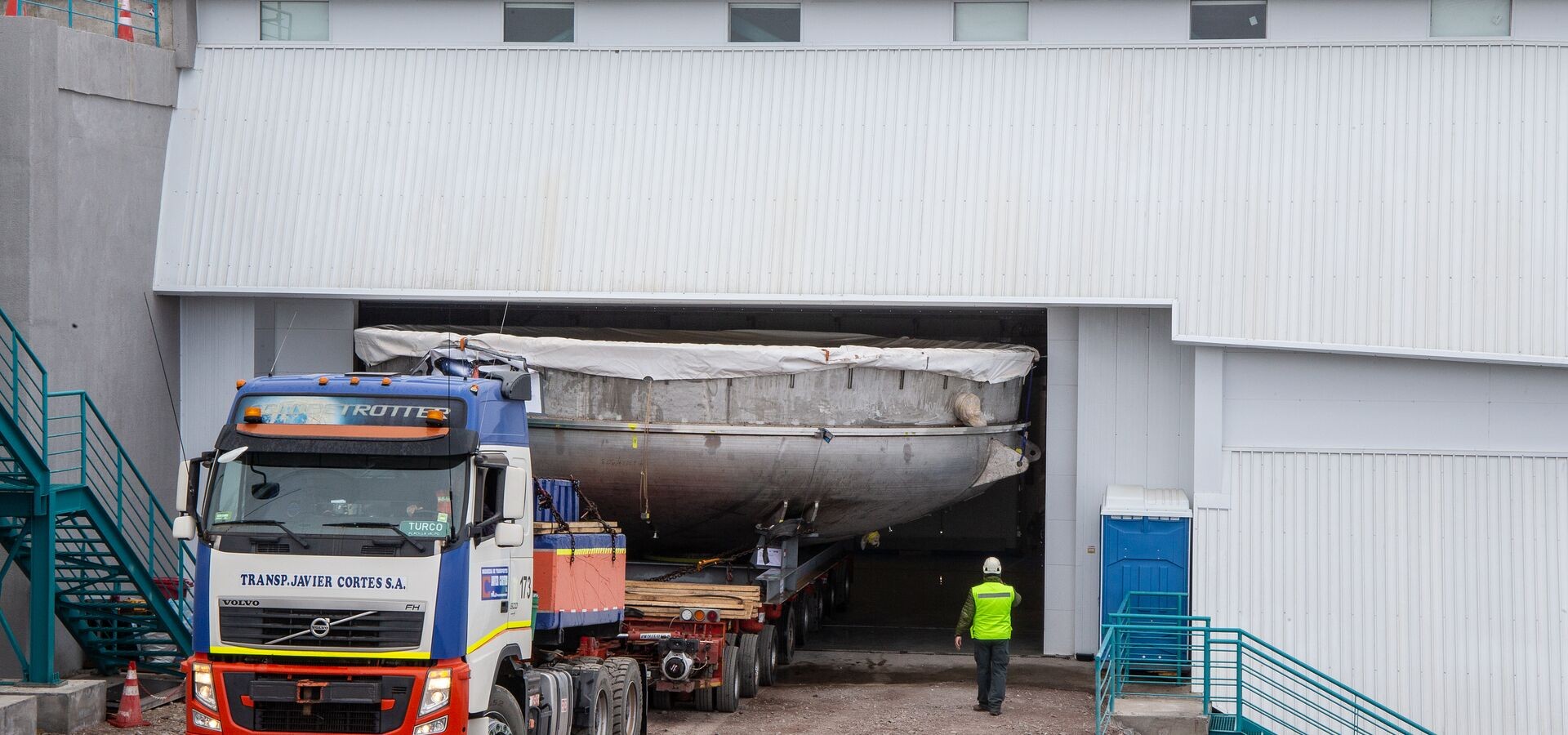
LSST Coating Chamber Arrival

Media

LSST Coating Chamber Arrival

Related News Posts

Loading the News...
Go Back to News Posts

LSST Coating Chamber Arrives On Cerro Pachón

November 11, 2018
Cerro Pachón, Chile - The Coating Chamber for the Large Synoptic Survey Telescope (LSST) arrived on the summit of Cerro Pachón today, safely completing a 15 week journey from Deggendorf, Germany, where it was constructed. The 128-ton Coating Chamber is the largest single piece of equipment to arrive at the LSST observatory site to date, and will soon be joined by the Telescope Mount Assembly (TMA), from Spain, and the 8.4-meter Primary/Tertiary (M1M3) Mirror, from the United States, which are expected to arrive in 2019.

LSST, currently under construction in Chile, is an integrated system designed to conduct an unprecedented decade-long survey of the optical sky. Featuring an 8-meter class widefield ground-based telescope, a 3.2 Gpix camera, and an automated data processing system, LSST is supported by major funding from the National Science Foundation (NSF), with additional funding by the Department of Energy (DOE) Office of Science and the LSST Corporation.

The LSST Coating Chamber will be used to coat both of LSST’s mirrors with a highly reflective metallic layer before the 10-year survey begins, and will also recoat the mirrors periodically during Operations. It’s anticipated that the 8.4-meter diameter Primary/Tertiary Mirror (M1M3) will need to be recoated every two years during LSST’s 10-year survey, and the 3.5-meter diameter Secondary Mirror (M2) every five years.

Constructed by LSST subcontractor Von Ardenne over 30 months at the MAN factory in Deggendorf, Germany, the Coating Chamber received final factory acceptance in June of 2018, and was then prepared for shipping and transported by river barge to Antwerp, Belgium. On September 7, 2018, it was loaded by crane aboard the BBC Arizona, the ship that carried it to Chile.

After arriving at the Port of Coquimbo Terminal in Chile on October 23rd, it was divided into two parts, upper and lower, and transported by Javier Cortez, S.A. in specialized trucks from Coquimbo to the LSST summit facility on Cerro Pachón. The width of the cargo load was about 9 meters (29.5 feet), so this transport required cooperation between many parties to coordinate logistics, including the removal of hanging signs, utility cables, lights, etc. along the route. Local police provided an escort for the transport vehicles, and various authorities assisted with road closures and permits to proceed. Victor Krabbendam, LSST Project Manager, remarked that “it was gratifying to see so much support from the local communities, and the extensive cooperation between AURA, the Chilean authorities, and the many experts involved in the transportation activities. Considering the scale of the cargo, and the distance it needed to go, the move went remarkably smoothly.”

According to Tomislav Vucina, LSST Coatings Engineer, "The LSST Coating Chamber will be the largest, most modern, and most powerful mirror coating mechanism used by any telescope in the world." Now that this important component has been successfully received on the summit of Cerro Pachón, a six-month program of assembly, integration, and commissioning for the Coating Plant will begin, culminating with the coating of the Primary/Tertiary Mirror (M1M3) with protective aluminum, and the Secondary Mirror (M2) with protective silver. 

 Edward Ajhar, the National Science Foundation (NSF) Program Manager for LSST, commented, “NSF is very excited to see this major milestone in LSST construction completed safely and on time. We are looking forward to the ground-breaking discoveries LSST will bring to the astronomical community.”

More Information

About LSST 

LSST’s mission is to build a well-understood system that provides a vast astronomical data set for unprecedented discovery of the deep and dynamic Universe. LSST seeks to enable science in four main areas: understanding dark matter and dark energy, cataloging the Solar System, exploring the changing sky, and investigating the formation and structure of the Milky Way. LSST is scheduled to begin operations in 2022. More information can be found at www.lsst.org

Financial support for LSST comes from the National Science Foundation (NSF) through Cooperative Agreement No. 1258333, the Department of Energy (DOE) Office of Science under Contract No. DE-AC02-76SF00515, and private funding raised by the LSST Corporation. The NSF-funded LSST Project Office for construction was established as an operating center under management of the Association of Universities for Research in Astronomy (AURA). The DOEfunded effort to build the LSST camera is managed by the SLAC National Accelerator Laboratory (SLAC). 

The National Science Foundation (NSF) is an independent federal agency created by Congress in 1950 to promote the progress of science. NSF supports basic research and people to create knowledge that transforms the future. 

About AURA

The Association of Universities for Research in Astronomy (AURA) is an international consortium of universities and non-profit institutions that operate world-class astronomy facilities. In Chile, it administers and operates the telescopes of Cerro Tololo, Gemini South, SOAR, and in the future LSST under a cooperative agreement with the National Science Foundation of the United States.

Learn more about this release on NOIRLab.edu

Links

Contacts

  • Ranpal Gill
    LSST Communications Manager
    rgill@lsst.org