
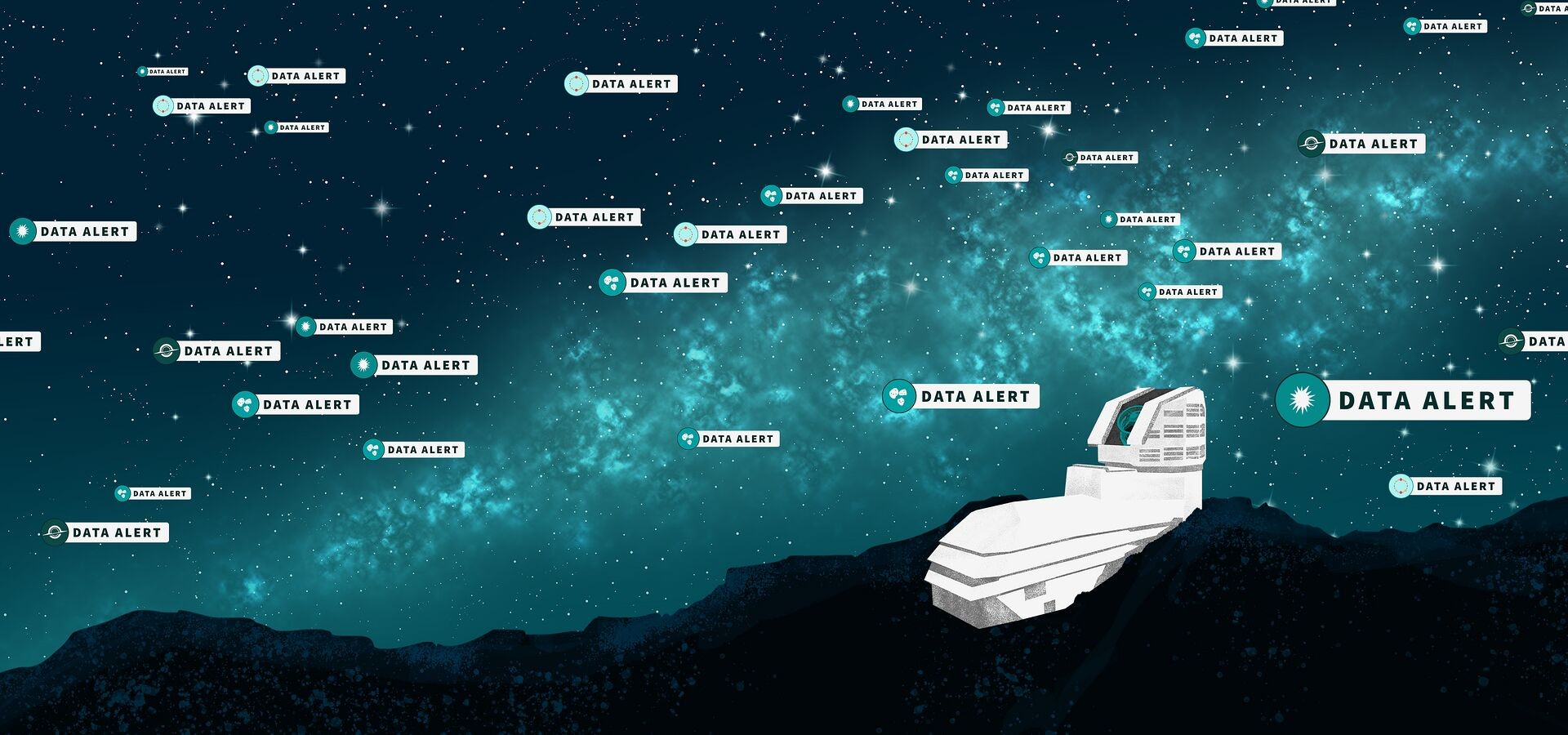
NSF–DOE Vera C. Rubin Observatory Launches Real-Time Discovery Machine for Monitoring the Night Sky
NSF–DOE Vera C. Rubin Observatory, jointly funded by the U.S. National Science Foundation (NSF) and the U.S. Department of Energy's Office of Science (DOE/SC), has released its first alerts documenting astronomical events spotted by the observatory. Rubin issued 800,000 alerts the night of 24 February. These alerts called scientists’ attention to new asteroids, exploding stars, and other changes in the night sky. This milestone marks the launch of a system expected to eventually produce up to seven million alerts per night.
Among the first alerts are detections of supernovae, variable stars, active galactic nuclei, and objects whizzing around our Solar System, such as asteroids. The beginning of scientific alerts is one of the last major milestones before Rubin Observatory begins its Legacy Survey of Space and Time (LSST) later this year. During the LSST, Rubin will scan the Southern Hemisphere sky nightly for ten years to precisely capture every visible change using the largest digital camera ever made. These alerts will chronicle the treasure trove of scientific discoveries that Rubin will make through its time-lapse record of the Universe. In the first year of the LSST, Rubin is expected to capture images of more objects than all other optical observatories combined in human history.
“By connecting scientists to a vast and continuous stream of information, NSF–DOE Rubin Observatory will make it possible to follow the Universe’s events as they unfold, from the explosive to the most faint and fleeting,” says Luca Rizzi, a program director for research infrastructure at NSF.
“The discoveries reported in these alerts reflect the power of NSF–DOE Rubin Observatory as a tool for astrophysics and the importance of sustained federal support,” says Kathy Turner, program manager in the High Energy Physics program in the DOE’s Office of Science. “Rubin Observatory’s groundbreaking capabilities are revealing untold astrophysical treasures and expanding scientists’ access to the ever-changing cosmos.”
Rubin’s alerts will power discoveries in many areas of astronomy, astrophysics, and cosmology. While the night sky seems calm and unchanging to the casual viewer, it’s actually alive with motion and transformation. Each alert signals something that has changed in the sky since Rubin last looked — a new source of light, a star that brightened or dimmed, or an object that moved. With Rubin's alerts, scientists will have a greater ability to catch supernovae in their earliest moments, discover and track asteroids to assess potential threats to Earth, and spot rare interstellar objects as they race through the Solar System. Scientists can then use these data to better understand the nature of dark matter, dark energy, and other unknown aspects of the Universe.
“Rubin's alert system was designed to allow anyone to identify interesting astronomical events with enough notice to rapidly obtain time-critical follow-up observations,” says Eric Bellm, Alert Production Pipeline Group Lead for Rubin Data Management from NSF NOIRLab and the University of Washington. “Enabling real-time discovery on 10 terabytes of images nightly has required years of technical innovation in image processing algorithms, databases, and data orchestration. We can’t wait to see the exciting science that comes from these data.”
The near-real-time public nature of Rubin’s alert system enables scientists using other ground and space-based telescopes around the world to coordinate follow-up observations like never before. This collaboration will enable fast and detailed studies of unfolding phenomena.
The first Rubin Observatory alerts distributed to researchers worldwide were generated on the night of 24 February. The alerts contained the flares of new supernovae and the flickers of stars, actively feeding black holes in distant galaxies, and asteroids cruising through our Solar System.
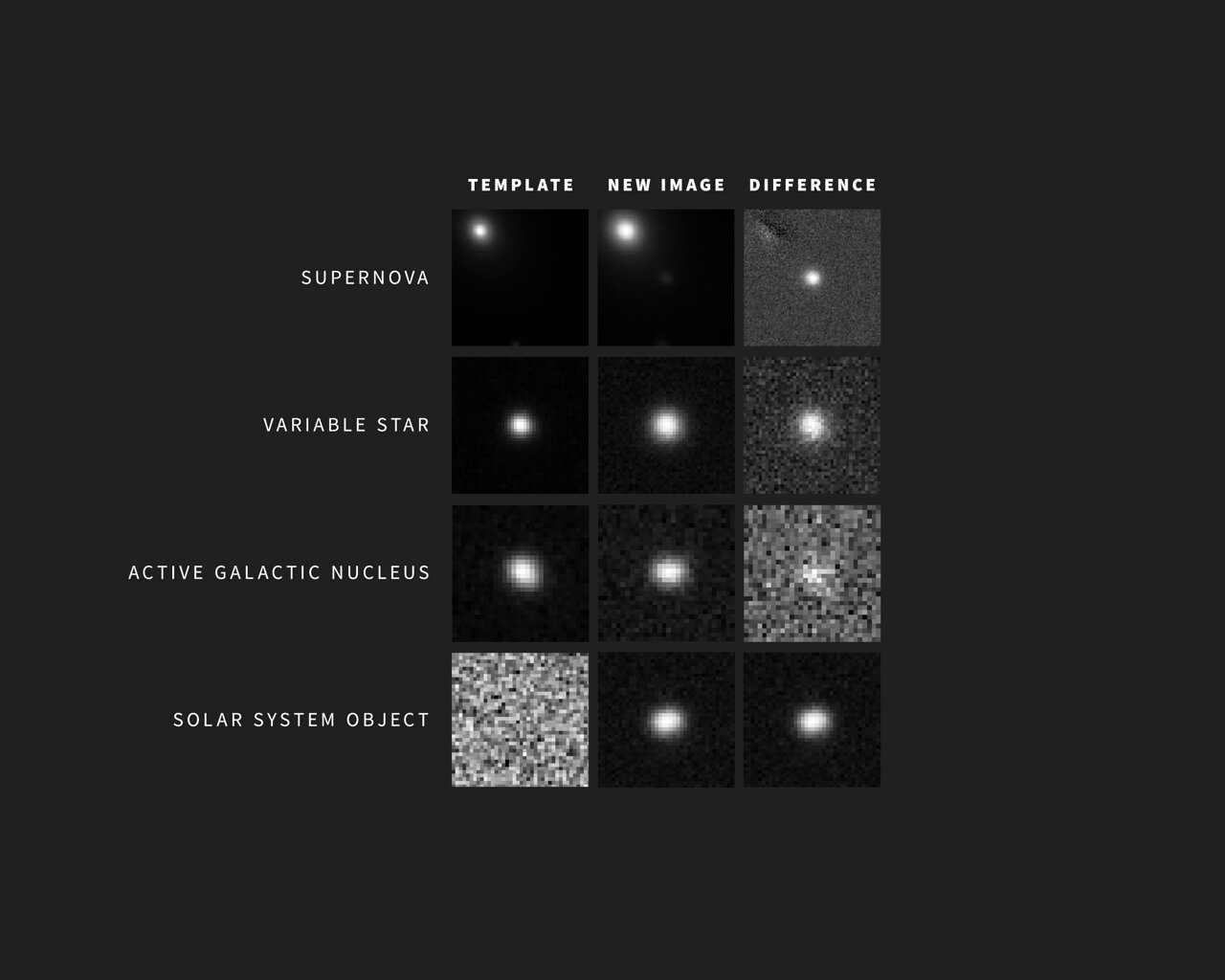
Capturing the Changing Cosmos: Examples of Alerts from NSF–DOE Rubin Observatory
As new images are taken, Rubin Observatory’s sophisticated software automatically compares each one with a template image. The template image, built by combining Rubin’s previous images of the same area in the same filter, is subtracted from the new image, leaving only the changes. Each change triggers an alert within two minutes of image capture. The vast majority of these alerts are supernovae, variable stars, active galactic nuclei, and Solar System objects. The individual images above are “postage stamps” of objects observed by Rubin that changed from one visit to the next. For each of these example alerts, the left shows the template image, the center shows the new image, and the right shows the subtracted, or difference, image. The object of interest for a particular alert is centered in the images. In the case of the supernova above, the bright spots in the upper left corners of the template and new images are the center of the supernova’s host galaxy. The supernova itself — not seen in the template image — is clearly revealed in the center of the difference image.
Credit: NSF–DOE Vera C. Rubin Observatory/NOIRLab/SLAC/AURA. Acknowledgement: Alert images with classifications provided by ALeRCE and Lasair.
Located in Chile, Rubin Observatory is jointly operated by NSF NOIRLab and DOE’s SLAC National Accelerator Laboratory. The telescope is equipped with the LSST Camera, the largest digital camera ever built. With 3200 megapixels, Rubin is capable of detecting faint and distant objects in the Universe.
Every 40 seconds during nighttime observations, Rubin captures a new region of the sky. It then sends the data on a seconds-long journey from Chile to the U.S. Data Facility (USDF) at SLAC in California for initial processing. Rubin’s data management system automatically compares it to a template made from previous images of the same region. This comparison allows it to detect the slightest variations. With every change, such as the appearance of a new point of light, an object’s movement, or a change in brightness, the system generates a public alert within a record two-minute interval. With such a large and sensitive camera, and the ability to quickly process historic amounts of data, Rubin can produce up to seven million alerts each night.
“The scale and speed of the alerts are unprecedented,” says Hsin-Fang Chiang, a SLAC software developer leading operations for data processing at the USDF. “After generating hundreds of thousands of test alerts in the last few months, we are now able to say, within minutes, with each image, ‘here is everything’ and ‘go’.”
To interpret the immense flow of data from the Rubin alert stream, scientists rely on a network of intelligent software platforms known as brokers. These systems use machine learning algorithms to filter, sort, and classify the alerts before distributing them to scientific teams and observatories.
“The extraordinary number of alerts that Rubin will produce presents an exciting challenge for both astronomers and software engineers,” explains Tom Matheson, Interim Director of the Community Science and Data Center (CSDC), a Program of NSF NOIRLab, and head of Time-Domain Services, which developed the ANTARES alert broker. “The broker teams have built systems that operate rapidly at scale so that scientists can find all of the objects of interest to them, as well as things we’ve never seen before.”
Brokers also cross-reference alerts with data from multi-wavelength astronomical catalogs. Some of them specialize in specific types of objects and events. These events include early identification of supernovae and Solar System objects. Identifying these events early allows scientists to provide tailored analysis and respond more quickly.
“What’s revolutionary about Rubin is its ability to capture both rapid changes and long-term evolution in the sky,” explains Rosaria Bonito, researcher at the Italian National Institute for Astrophysics (INAF) in Palermo, Italy, and co-chair of the Rubin LSST Transients and Variable Stars (TVS) science collaboration. “Young stars, for example, are highly dynamic and can experience sudden bursts of brightness caused by infalling matter. These events are often short-lived, and scientists can easily miss them without continuous monitoring. Rubin will allow us to detect these changes as they happen right there, right now, and also to track the evolution of stars over a decade.”
Rubin’s alerts are public to the world, meaning anyone — from professional researchers to students and citizen scientists — can access and explore them. Alerts can be accessed through any of the seven official community brokers, as well as two downstream services. These services form an international network that enables prompt, real-time data exploration from anywhere on Earth. Additionally, through collaborations with platforms like Zooniverse, Rubin will empower the global community to classify cosmic events and contribute directly to discovery.
Official brokers for Rubin data are: ALeRCE, AMPEL, ANTARES, Babamul, Fink, Lasair, Pitt-Google, SNAPS, and POI Broker.
More Information
NSF–DOE Vera C. Rubin Observatory, funded by the U.S. National Science Foundation and the U.S. Department of Energy’s Office of Science, is a groundbreaking new astronomy and astrophysics observatory on Cerro Pachón in Chile. It is named after astronomer Vera Rubin, who provided the first convincing evidence for the existence of dark matter. Using the largest camera ever built, Rubin will repeatedly scan the sky for 10 years to create an ultra-wide, ultra-high-definition, time-lapse record of our Universe.
NSF–DOE Vera C. Rubin Observatory is a joint initiative of the U.S. National Science Foundation (NSF) and the U.S. Department of Energy’s Office of Science (DOE/SC). Its primary mission is to carry out the Legacy Survey of Space and Time, providing an unprecedented data set for scientific research supported by both agencies. Rubin is operated jointly by NSF NOIRLab and SLAC National Accelerator Laboratory. NSF NOIRLab is managed by the Association of Universities for Research in Astronomy (AURA) and SLAC is operated by Stanford University for the DOE. France provides key support to the construction and operations of Rubin Observatory through contributions from CNRS/IN2P3. Rubin Observatory is privileged to conduct research in Chile and gratefully acknowledges additional contributions from more than 40 international organizations and teams.
The U.S. National Science Foundation (NSF) is an independent federal agency created by Congress in 1950 to promote the progress of science. NSF supports basic research and people to create knowledge that transforms the future.
The DOE’s Office of Science is the single largest supporter of basic research in the physical sciences in the United States and is working to address some of the most pressing challenges of our time.
NSF NOIRLab, the U.S. National Science Foundation center for ground-based optical-infrared astronomy, operates the International Gemini Observatory (a facility of NSF, NRC–Canada, ANID–Chile, MCTIC–Brazil, MINCyT–Argentina, and KASI–Republic of Korea), NSF Kitt Peak National Observatory (KPNO), NSF Cerro Tololo Inter-American Observatory (CTIO), the Community Science and Data Center (CSDC), and NSF–DOE Vera C. Rubin Observatory (in cooperation with DOE’s SLAC National Accelerator Laboratory). It is managed by the Association of Universities for Research in Astronomy (AURA) under a cooperative agreement with NSF and is headquartered in Tucson, Arizona.
The scientific community is honored to have the opportunity to conduct astronomical research on I’oligam Du’ag (Kitt Peak) in Arizona, on Maunakea in Hawai‘i, and on Cerro Tololo and Cerro Pachón in Chile. We recognize and acknowledge the very significant cultural role and reverence of I’oligam Du’ag (Kitt Peak) to the Tohono O’odham Nation, and Maunakea to the Kanaka Maoli (Native Hawaiians) community.
SLAC National Accelerator Laboratory explores how the Universe works at the biggest, smallest and fastest scales and invents powerful tools used by researchers around the globe. As world leaders in ultrafast science and bold explorers of the physics of the Universe, we forge new ground in understanding our origins and building a healthier and more sustainable future. Our discovery and innovation help develop new materials and chemical processes and open unprecedented views of the cosmos and life’s most delicate machinery. Building on more than 60 years of visionary research, we help shape the future by advancing areas such as quantum technology, scientific computing and the development of next-generation accelerators. SLAC is operated by Stanford University for the U.S. Department of Energy’s Office of Science.
Contactos
- Josie FenskePublic Information OfficerNSF NOIRLab
- Aaron GroffMedia Relations LeadSLAC National Accelerator Laboratory