
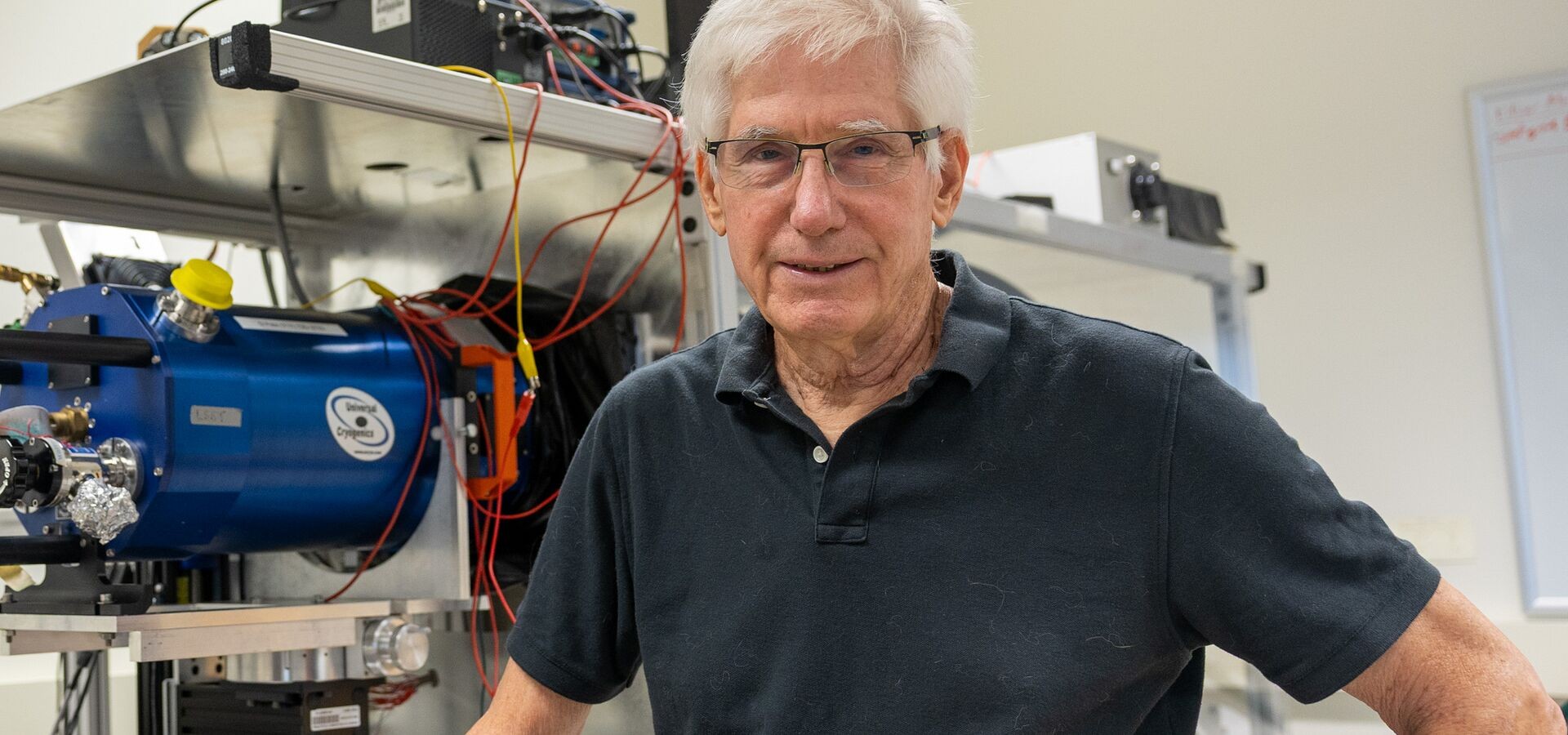
NSF–DOE Rubin Observatory Founding Director Tony Tyson Included in 2026 TIME100
Astronomer Tony Tyson of the University of California, Davis, whose vision laid the foundation for NSF–DOE Vera C. Rubin Observatory, has been included in the 2026 TIME100, TIME’s annual list recognizing the 100 most influential people in the world.
Rubin Observatory is funded by the U.S. National Science Foundation (NSF) and the U.S. Department of Energy’s Office of Science (DOE/SC). Rubin is a joint program between NSF NOIRLab and DOE’s SLAC National Accelerator Laboratory, who cooperatively operate Rubin. NOIRLab is managed by the Association of Universities for Research in Astronomy (AURA).
The TIME100 list highlights individuals whose impact, innovation, and achievements are shaping the future across science, culture, and society. Tyson’s inclusion recognizes his pioneering contributions to cosmology and his leadership in advancing one of the most ambitious astronomical surveys ever undertaken.
“Thirty years ago, astronomer Tony Tyson had the vision to suggest this intriguing path, and the persistence to build something many thought impossible. Throughout the construction, Tony, as chief scientist, played a critical role in tackling some of the thorniest research problems, pushing the boundaries of detector and survey design and transforming a bold idea into a flagship observatory,” writes Risa Wechsler, Professor and Cosmologist at SLAC National Accelerator Laboratory and Stanford, for TIME.
As founding Director of Rubin Observatory, Tyson has been instrumental in shaping the Legacy Survey of Space and Time (LSST), a decade-long effort poised to transform our understanding of the Universe — from the invisible forces of dark matter and dark energy to the ever-changing sky and the structure of our home galaxy, the Milky Way.
“I’m deeply honored to be included in the TIME100,” says Tyson. “This recognition reflects the extraordinary work of the many scientists, engineers, and partners behind Rubin Observatory. Together, we are building a new way of seeing the Universe — one that will open discovery to the global community and inspire the next generation.”
“Tony Tyson’s vision has helped redefine how we explore the Universe,” says Bob Blum, Director of Operations for Rubin Observatory. “His work exemplifies the power of innovation and collaboration in pushing the boundaries of discovery.”
The full TIME100 list and tributes appear in the 27 April 2026 issue of TIME, available on newsstands 17 April, and now online here.
More information
NSF–DOE Vera C. Rubin Observatory, funded by the U.S. National Science Foundation and the U.S. Department of Energy’s Office of Science, is a groundbreaking new astronomy and astrophysics observatory on Cerro Pachón in Chile. It is named after astronomer Vera Rubin, who provided the first convincing evidence for the existence of dark matter. Using the largest camera ever built, Rubin will repeatedly scan the sky for 10 years to create an ultra-wide, ultra-high-definition, time-lapse record of our Universe.
NSF–DOE Vera C. Rubin Observatory is a joint initiative of the U.S. National Science Foundation (NSF) and the U.S. Department of Energy’s Office of Science (DOE/SC). Its primary mission is to carry out the Legacy Survey of Space and Time, providing an unprecedented data set for scientific research supported by both agencies. Rubin is operated jointly by NSF NOIRLab and SLAC National Accelerator Laboratory. NSF NOIRLab is managed by the Association of Universities for Research in Astronomy (AURA) and SLAC is operated by Stanford University for the DOE. France provides key support to the construction and operations of Rubin Observatory through contributions from CNRS/IN2P3. Rubin Observatory is privileged to conduct research in Chile and gratefully acknowledges additional contributions from more than 40 international organizations and teams.
The U.S. National Science Foundation (NSF) is an independent federal agency created by Congress in 1950 to promote the progress of science. NSF supports basic research and people to create knowledge that transforms the future.
The DOE’s Office of Science is the single largest supporter of basic research in the physical sciences in the United States and is working to address some of the most pressing challenges of our time.
NSF NOIRLab, the U.S. National Science Foundation center for ground-based optical-infrared astronomy, operates the International Gemini Observatory (a facility of NSF, NRC–Canada, ANID–Chile, MCTIC–Brazil, MINCyT–Argentina, and KASI–Republic of Korea), NSF Kitt Peak National Observatory (KPNO), NSF Cerro Tololo Inter-American Observatory (CTIO), the Community Science and Data Center (CSDC), and NSF–DOE Vera C. Rubin Observatory (in cooperation with DOE’s SLAC National Accelerator Laboratory). It is managed by the Association of Universities for Research in Astronomy (AURA) under a cooperative agreement with NSF and is headquartered in Tucson, Arizona.
The scientific community is honored to have the opportunity to conduct astronomical research on I’oligam Du’ag (Kitt Peak) in Arizona, on Maunakea in Hawai‘i, and on Cerro Tololo and Cerro Pachón in Chile. We recognize and acknowledge the very significant cultural role and reverence of I’oligam Du’ag (Kitt Peak) to the Tohono O’odham Nation, and Maunakea to the Kanaka Maoli (Native Hawaiians) community.
SLAC National Accelerator Laboratory explores how the Universe works at the biggest, smallest and fastest scales and invents powerful tools used by researchers around the globe. As world leaders in ultrafast science and bold explorers of the physics of the Universe, we forge new ground in understanding our origins and building a healthier and more sustainable future. Our discovery and innovation help develop new materials and chemical processes and open unprecedented views of the cosmos and life’s most delicate machinery. Building on more than 60 years of visionary research, we help shape the future by advancing areas such as quantum technology, scientific computing and the development of next-generation accelerators. SLAC is operated by Stanford University for the U.S. Department of Energy’s Office of Science.
More Information
Learn more about this release on NOIRLab.eduContacts
Josie Fenske
Public Information Officer
NSF NOIRLab
Email: josie.fenske@noirlab.edu
Aaron Groff
Media Relations Lead
SLAC National Accelerator Laboratory
Email: agroff@slac.stanford.edu