Localize site content
Homepage
    • About
    • History
    • Who was Vera Rubin?
      • Rubin in Chile
      • Cerro Pachón
      • Observatory Site Selection
      • Organization
      • Leadership
      • Science Collaborations
    • Funding Information
      • Work With Us
      • Jobs Board
    • Explore
    • Rubin Basics
    • Science Goals
      • How Rubin Works
      • Legacy Survey of Space and Time (LSST)
      • Rubin Technology
      • Alert Stream
      • Rubin Numbers
    • Rubin Voices
      • Skyviewer ↗
      • Skysynth: The cosmos captured by Rubin, for your ears
    • Orbitviewer ↗
    • Get Involved in Rubin Research
      • Activities, Games, and More
      • Space Surveyors Game
      • Animated Video Series
    • Gallery
      • Main Gallery
      • Featured Media
      • News Gallery
      • First Look
      • Graphics & Illustrations
      • Outreach & Education
    • Slideshows
    • Construction Archive Gallery
    • Media Use Policy
    • News
    • Press Releases
      • Rubin Observatory First Look
      • The Cosmic Treasure Chest
      • A Swarm of New Asteroids
      • Rhythms in the Stars
      • Trifid and Lagoon Nebulae
      • Rubin First Look Watch Parties
    • Media Resources
    • Press Releases
    • Name Guidelines
    • For Scientists
    • Get started
      • News, events, and deadlines
      • Rubin Science Assemblies
      • Rubin Data Academy
      • Rubin Community Workshop
      • Resources for scientists
      • Rubin Community Forum
      • Early Science Program
      • Workshops and seminars
      • Tutorials
      • LSST Discovery Alliance
      • Public outreach materials
      • For amateur astronomers
      • Survey, instruments, and telescopes
      • Key numbers
      • The Legacy Survey of Space and Time (LSST)
      • Instruments
      • Telescopes
      • Data products, pipelines, and services
      • Data Policy
      • Data access and analysis
      • Recent data releases
      • Alerts and brokers
      • Data processing pipelines
      • User-contributed resources
      • Future data products
      • Simulation software
      • Documentation and publications
      • Technical documentation
      • How to cite Rubin Observatory
      • Publication policies
      • Glossary & Acronyms
      • Papers citing Rubin Observatory
      • Science Collaborations
      • Galaxies Science Collaboration
      • Stars, Milky Way, and Local Volume Science Collaboration
      • Solar System Science Collaboration
      • Dark Energy Science Collaboration
      • Active Galactic Nuclei Science Collaboration
      • Transients and Variable Stars Science Collaboration
      • Strong Lensing Science Collaboration
      • Informatics and Statistics Science Collaboration
    • Citizen Science
      • Committees and teams
      • Science Advisory Committee (SAC)
      • Survey Cadence Optimization Committee (SCOC)
      • Users Committee
      • Target of Opportunity (ToO) Advisory Board
      • Resource Allocation Committee (RAC)
      • Community Science Team (CST)
      • Research Inclusion Working Group (RIWG)
      • Project Science Team (PST)
      • In Kind Program
      • In-Kind Program FAQs
      • Frequently Asked Questions
      • Impacts from artificial satellites and debris
      • How to navigate this website
      • Code of Conduct
      • Interim CoC
    • Education
    • First Look Resources for Lasting Impact
    • Education FAQs
    • Educators
    • Glossary
    • Investigations
    • Calendar
Localize site content
  • Contact Us
  • Jobs Board
  • Intranet
  • Visual Identity Guide
  • Privacy Policy

The U.S. National Science Foundation (NSF) and the U.S. Department of Energy (DOE) Office of Science will support Rubin Observatory in its operations phase to carry out the Legacy Survey of Space and Time. They will also provide support for scientific research with the data. During operations, NSF funding is managed by the Association of Universities for Research in Astronomy (AURA) under a cooperative agreement with NSF, and DOE funding is managed by SLAC National Accelerator Laboratory (SLAC), under contract by DOE. Rubin Observatory is operated by NSF NOIRLab and SLAC.

NSF is an independent federal agency created by Congress in 1950 to promote the progress of science. NSF supports basic research and people to create knowledge that transforms the future.

The DOE Office of Science is the single largest supporter of basic research in the physical sciences in the United States and is working to address some of the most pressing challenges of our time.

Funding agency logos

Let's Connect

  • Visit the Rubin Observatory on Facebook
  • Visit the Rubin Observatory on Instagram
  • Visit the Rubin Observatory on LinkedIn
  • Visit the Rubin Observatory on Twitter
  • Visit the Rubin Observatory on YouTube
    1. Explore
    2. Rubin Basics
    3. Near-Earth Objects

    Media

    Tags

    • #asteroid
    • #comet
    • #solar system

    Related Rubin Basics Posts

    Loading the Rubin Basics...
    Go Back to Rubin Basics Posts

    Near-Earth Objects

    Some objects in our Solar System have orbits that bring them close to Earth. How will Rubin help us keep an eye on them?

    In movies, asteroid threats usually come with dramatic music and last-minute heroics as a single rock hurtles towards Earth. But how do real-life scientists find smaller, harder-to-spot space rocks that could someday become a problem? In the real world, identifying asteroids that could threaten Earth is less about one looming object and more about watching lots of small ones over time.

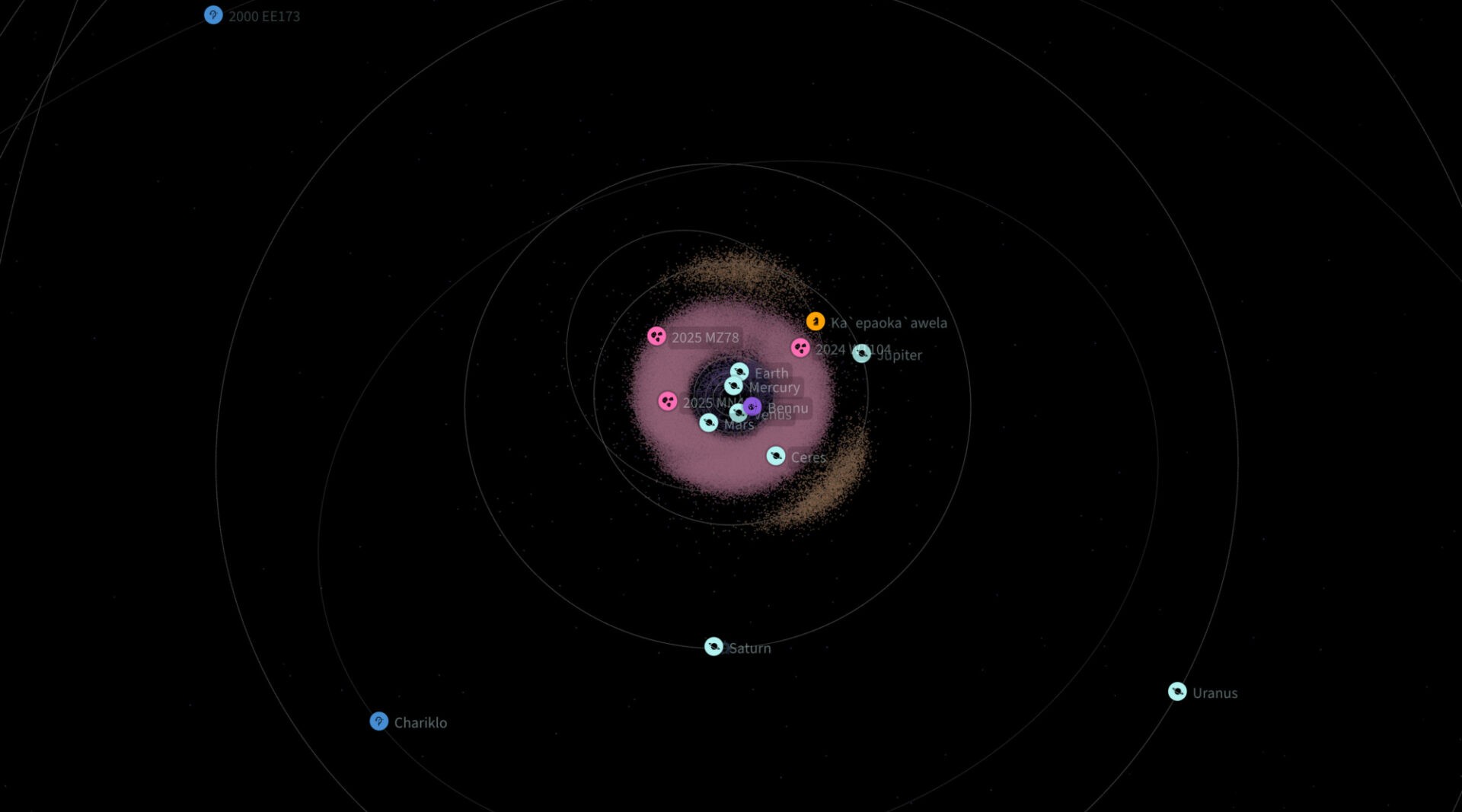
    Near-Earth objects (NEOs) are small Solar System bodies, mostly asteroids with some comets mixed in, whose orbits bring them close to Earth. Knowing where they are and where they’re headed is important, and many of them are challenging to spot because they’re small, faint, and on the move.

    While scientists have already identified most of the really large NEOs (over a kilometer wide), only about a third of the mid-range ones (larger than 140 meters) have been discovered. Objects that size are still big enough to cause serious damage if they end up on a collision course with Earth — an unlikely event but not impossible, which is why scientists pay close attention to these objects long before they pose any real risk.

    Rubin’s powerful telescope and its ability to scan the entire visible sky every few nights will enable us to fill in the blanks in our NEO inventory. Using Rubin data, scientists expect to discover millions of previously unseen asteroids throughout our Solar System. Of these, about 90,000 will be brand new NEOs — more than double the number currently known.

    In addition to spotting new NEOs in the first place, Rubin’s frequent imaging — and the alerts Rubin sends out for moving objects it detects — will ensure that scientists can keep close tabs on interesting or concerning asteroids.

    Rubin Observatory will help transform asteroid detection from science fiction into everyday science — a steady, systematic effort to find, track, and understand near-Earth objects long before they might pose a threat.

    Further exploration:

    • Explore NEOs and other Rubin Solar System discoveries in the Orbitviewer app

    • Watch A Swarm of New Asteroids, a video featuring Rubin’s first asteroid discoveries

    • Check out the record-breaking fast-spinning asteroid discovered with Rubin data

    • Contribute to Rubin science with the Comet Catchers project on Zooniverse

    • Educators, engage your students in a Hazardous Asteroids investigation