Localize site content
    • About
    • History
    • Who was Vera Rubin?
      • Rubin in Chile
      • Cerro Pachón
      • Observatory Site Selection
      • Organization
      • Leadership
      • Science Collaborations
      • Departments and Teams
    • Funding Information
      • Work With Us
      • Jobs Board
    • Explore
      • How Rubin Works
      • Legacy Survey of Space and Time (LSST)
      • Rubin Technology
      • Alert Stream
      • Rubin Numbers
    • Science Goals
      • Skyviewer ↗
      • Skysynth: The cosmos captured by Rubin, for your ears
    • Orbitviewer ↗
    • Rubin Voices
    • Get Involved in Rubin Research
      • Activities, Games, and More
      • Space Surveyors Game
      • Animated Video Series
      • Rubin's 3200-Megapixel Group Photo
    • Gallery
      • Main Gallery
      • First Look
      • Graphics & Illustrations
      • Outreach & Education
    • Slideshows
    • Construction Archive Gallery
    • Media Use Policy
    • News
    • Press Releases
      • Rubin Observatory First Look
      • The Cosmic Treasure Chest
      • A Swarm of New Asteroids
      • Rhythms in the Stars
      • Trifid and Lagoon Nebulae
      • Rubin First Look Watch Parties
    • Media Resources
    • Press Releases
    • Name Guidelines
    • For Scientists
      • News, events, and deadlines
      • Rubin Science Assemblies
      • Rubin Data Academy
      • Rubin Community Workshop
      • Resources for scientists
      • Rubin Community Forum
      • Early Science Program
      • Workshops and seminars
      • Tutorials
      • LSST Discovery Alliance
      • Code of Conduct
      • Public outreach materials
      • Survey, instruments, and telescopes
      • Key numbers
      • The Legacy Survey of Space and Time (LSST)
      • Instruments
      • Telescopes
      • Data products, pipelines, and services
      • Data access and analysis
      • Recent data releases
      • Alerts and brokers
      • Data processing pipelines
      • Future data products
      • Data Policy
      • Simulation software
      • Documentation and publications
      • Technical documentation
      • How to cite Rubin Observatory
      • Publication policies
      • Glossary & Acronyms
      • Papers citing Rubin Observatory
      • Science Collaborations
      • Galaxies Science Collaboration
      • Stars, Milky Way, and Local Volume Science Collaboration
      • Solar System Science Collaboration
      • Dark Energy Science Collaboration
      • Active Galactic Nuclei Science Collaboration
      • Transients and Variable Stars Science Collaboration
      • Strong Lensing Science Collaboration
      • Informatics and Statistics Science Collaboration
    • Citizen Science
      • Committees and teams
      • Science Advisory Committee (SAC)
      • Survey Cadence Optimization Committee (SCOC)
      • Users Committee
      • Target of Opportunity (ToO) Advisory Board
      • Community Science Team (CST)
      • Research Inclusion Working Group (RIWG)
      • Project Science Team (PST)
      • In Kind Program
      • Resources
      • In-Kind Program FAQs
      • Frequently Asked Questions
      • How to navigate this website
    • Education
    • First Look Resources for Lasting Impact
    • Education FAQs
    • Educators
    • Glossary
    • Investigations
    • Calendar
Localize site content
Homepage
  • Contact Us
  • Jobs Board
  • Intranet
  • Visual Identity Guide
  • Privacy Policy

The U.S. National Science Foundation (NSF) and the U.S. Department of Energy (DOE) Office of Science will support Rubin Observatory in its operations phase to carry out the Legacy Survey of Space and Time. They will also provide support for scientific research with the data. During operations, NSF funding is managed by the Association of Universities for Research in Astronomy (AURA) under a cooperative agreement with NSF, and DOE funding is managed by SLAC National Accelerator Laboratory (SLAC), under contract by DOE. Rubin Observatory is operated by NSF NOIRLab and SLAC.

NSF is an independent federal agency created by Congress in 1950 to promote the progress of science. NSF supports basic research and people to create knowledge that transforms the future.

The DOE Office of Science is the single largest supporter of basic research in the physical sciences in the United States and is working to address some of the most pressing challenges of our time.

Funding agency logos

Let's Connect

  • Visit the Rubin Observatory on Facebook
  • Visit the Rubin Observatory on Instagram
  • Visit the Rubin Observatory on LinkedIn
  • Visit the Rubin Observatory on Twitter
  • Visit the Rubin Observatory on YouTube
    1. News
    2. Preparing for the greatest cosmic movie ever made

    Header image

    Media

    On a small platform five meters (16.4 feet) above the ground, wedged between the LSST camera and the telescope, Stuart Marshall, Camera Operations Scientist and Staff Scientist at SLAC, is working to connect the LSST camera's vacuum system.

Credit: RubinObs/NOIRLab/SLAC/NSF/DOE/AURA/Y. Utsumi
    On a small platform five meters (16.4 feet) above the ground, wedged between the LSST camera and the telescope, Stuart Marshall, Camera Operations Scientist and Staff Scientist at SLAC, is working to connect the LSST camera's vacuum system. Credit: RubinObs/NOIRLab/SLAC/NSF/DOE/AURA/Y. Utsumi
    Yijung Kang, Observing Specialist and Postdoctoral Researcher at SLAC, and Stuart Marshall, Camera Operations Scientist and Staff Scientist at SLAC, are working together to bring the LSST camera's vacuum system online.

Credit: RubinObs/NOIRLab/SLAC/NSF/DOE/AURA/Y. Utsumi
    Yijung Kang, Observing Specialist and Postdoctoral Researcher at SLAC, and Stuart Marshall, Camera Operations Scientist and Staff Scientist at SLAC, are working together to bring the LSST camera's vacuum system online. Credit: RubinObs/NOIRLab/SLAC/NSF/DOE/AURA/Y. Utsumi
    Securely harnessed, Yousuke Utsumi, Camera Operations Scientist and Associate Professor at the National Astronomical Observatory of Japan, and Stuart Marshall, Camera Operations Scientist and Staff Scientist at SLAC, are preparing to work on the LSST camera. 

Credit: RubinObs/NOIRLab/SLAC/NSF/DOE/AURA/T. Lange
    Securely harnessed, Yousuke Utsumi, Camera Operations Scientist and Associate Professor at the National Astronomical Observatory of Japan, and Stuart Marshall, Camera Operations Scientist and Staff Scientist at SLAC, are preparing to work on the LSST camera. Credit: RubinObs/NOIRLab/SLAC/NSF/DOE/AURA/T. Lange

    Tags

    • #LSST Camera
    • #Commissioning

    Related News Posts

    Loading the News...
    Go Back to News Posts
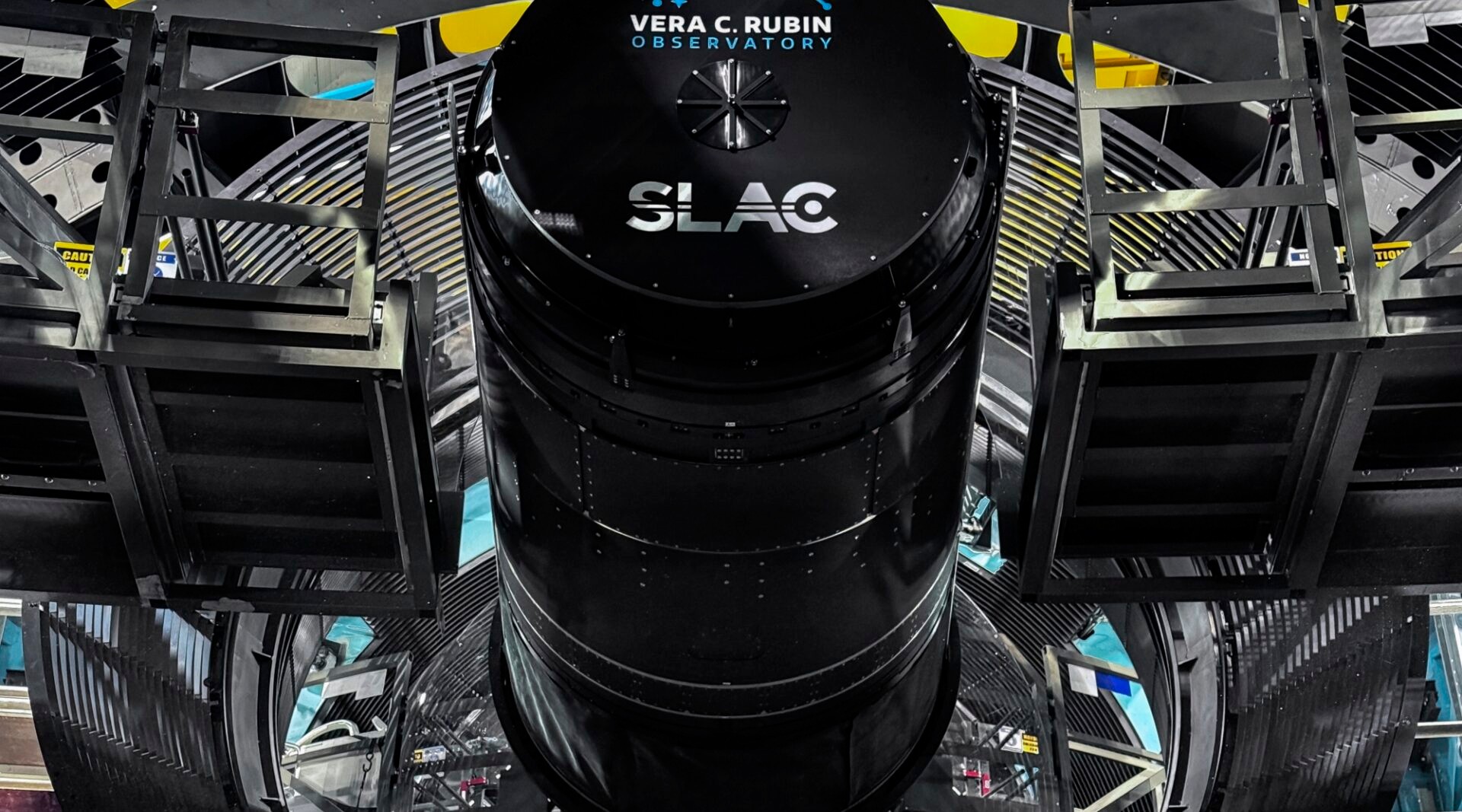
    The LSST Camera installed on the telescope

    Preparing for the greatest cosmic movie ever made

    April 11, 2025
    Now that NSF–DOE Vera C. Rubin Observatory’s LSST Camera has been installed, what’s next?

    High up on the top of Cerro Pachón in northern Chile, NSF–DOE Vera C. Rubin Observatory, funded by the U.S. National Science Foundation (NSF) and the U.S. Department of Energy’s Office of Science (DOE), is nearing completion. At the heart of the facility, a pivotal moment in the project’s scientific adventure is unfolding. After more than 20 years of meticulous research and development, and weeks of testing, the LSST Camera has been successfully installed on the Simonyi Survey Telescope.

    The teams breathe a collective sigh of relief. The world’s largest digital camera, built at the DOE SLAC National Accelerator Laboratory (SLAC), is now in place, and the anticipation of capturing the first images for the Legacy Survey of Space and Time (LSST) is palpable. The greatest astronomical movie ever made is about to begin.

    Well, almost.

    Starting up such a sophisticated camera is far more complicated than pressing a simple ‘on/off’ button. Creating the greatest astronomical film in history takes time, patience, and a commitment to precision. Every detail must be double-checked, and every system must meet its exact specifications before proceeding.

    At the telescope, the camera team continues to work diligently to ensure that everything is ready for its mission. This effort is carried out in collaboration with a large facility team, observing specialists who operate the telescope, and commissioning scientists who ensure that the instruments are properly installed and calibrated.

    Unlike in the past stages of construction, the camera team now operates five meters (16.4 feet) above the ground, securely harnessed to a small platform that supports no more than 125 kilograms (275 pounds). Their movements are limited by the camera’s rotation and the telescope’s mirrors, positioned just inches away. What might seem like a simple hose connection becomes an entirely new challenge under these conditions.
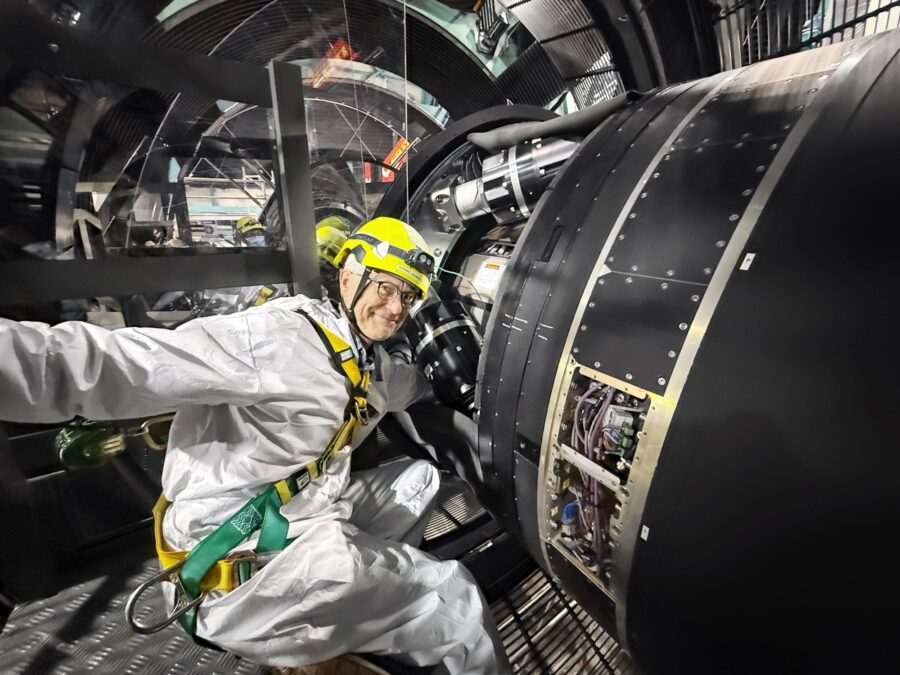
    On a small platform five meters (16.4 feet) above the ground, wedged between the LSST camera and the telescope, Stuart Marshall, Camera Operations Scientist and Staff Scientist at SLAC, is working to connect the LSST camera's vacuum system. Credit: RubinObs/NOIRLab/SLAC/NSF/DOE/AURA/Y. Utsumi

    The LSST Camera is about to undergo a series of critical steps. The first one is to create a vacuum inside the cryostat, a container designed to maintain extremely low temperatures, positioned in the middle of the camera. The cryostat houses the camera’s complex electronic systems and its mosaic of 189 charge-coupled device (CCD) science sensors. These sensors are designed to capture images of the night sky with exceptional precision, with each image made up of 3200 megapixels.

    With his hands inside the camera, working to connect the vacuum system, Stuart Marshall, Camera Operations Scientist and Staff Scientist at SLAC, explains, “The vacuum is crucial to insulate the camera’s electronics from temperature changes. Once we’ve ensured a stable vacuum, we’ll activate the refrigeration system which will cool the cryostat to very low temperatures.” The electronics generate about one kilowatt of heat during operation, roughly equivalent to the output of a small electric heater. This heat must be removed from the vacuum chamber to prevent overheating. “We want the camera’s electronics to be between –20°C and –5°C (–4°F and 23°F) to maintain a safe operating temperature. So we need to pull that heat out. And we do it by pumping a fluid at –50°C (–58°F) through the cooling system.”

    Meanwhile, the CCDs themselves must be cooled to –100°C (–148°F). This temperature ensures optimal performance and helps prevent unwanted heat from interfering with the sensitive electronics and degrading the quality of the images. These sensors have their own dedicated cooling system, which will only be activated once the electronic cooling system is stable. Once these critical steps are completed, the teams will power on the CCDs and test the control and data acquisition systems to ensure the camera communicates properly with the computers. The camera will then be fully operational.

    “Building the camera was never routine and we still have new challenges and problems to solve,” explains Marshall. “But now, as we’re getting ready for the first images, we are transferring the knowledge to the observing specialists and commissioning scientists who shadow our work and often drive the start-up, with supervision. It’s really exciting!”

    A few meters away, on the scaffold next to the camera, Yijung Kang, Observing Specialist and Postdoctoral Researcher at SLAC, is ready to operate the vacuum system. “All the observing team is really excited to prepare for operations! We are now working closely with the other teams, preparing tests and procedures to ensure the successful launch of our decade-long science mission. ”
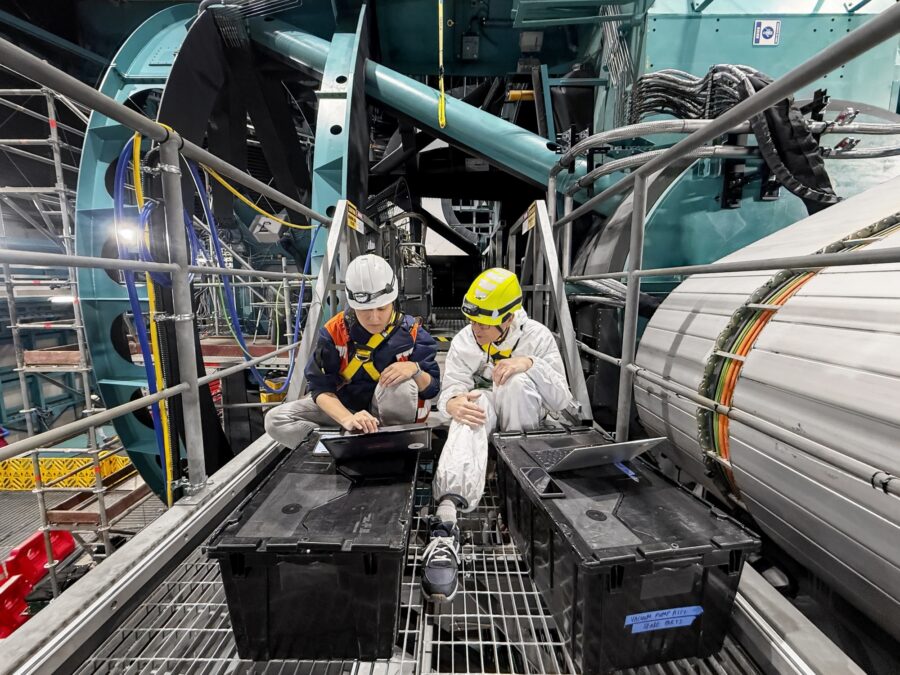
    Yijung Kang, Observing Specialist and Postdoctoral Researcher at SLAC, and Stuart Marshall, Camera Operations Scientist and Staff Scientist at SLAC, are working together to bring the LSST camera's vacuum system online. Credit: RubinObs/NOIRLab/SLAC/NSF/DOE/AURA/Y. Utsumi

    The work is methodical and demanding, and involves interconnected systems that require a comprehensive understanding of the entire camera. Experts in vacuum systems, cooling, and electronics play a critical role in the process. It is not enough to be an expert in one specific area — one must have a deep, holistic knowledge of the camera. Every system, every component, every adjustment must be carefully anticipated to ensure perfect operation.

    Yousuke Utsumi, Camera Operations Scientist and Associate Professor at the National Astronomical Observatory of Japan, knows the team is up to the challenge. “The work on the camera is progressing well, and we are confident that any issues that come up, even the most unexpected ones, will be resolved.”
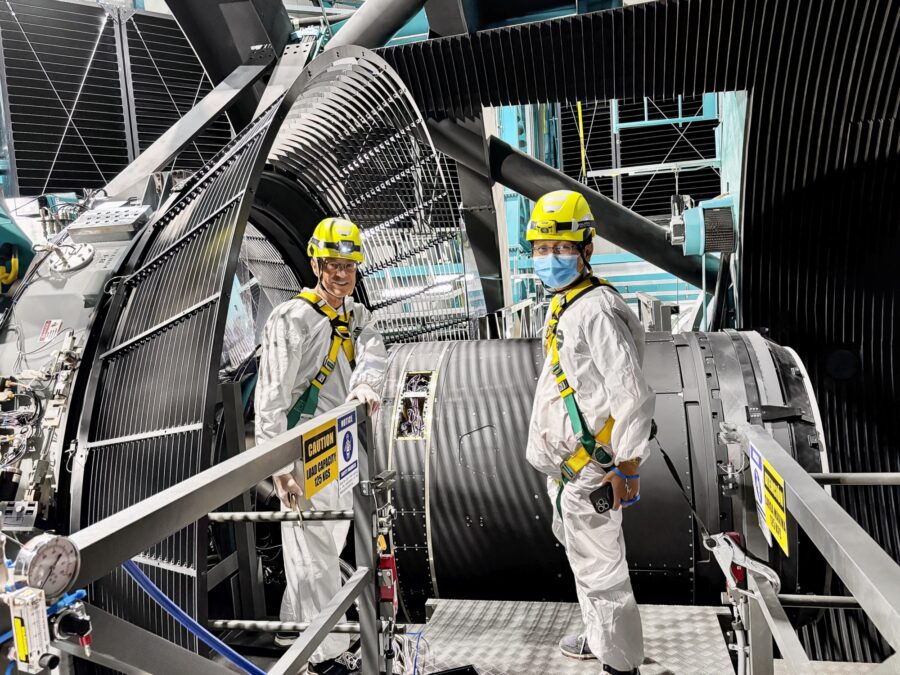
    Securely harnessed, Yousuke Utsumi, Camera Operations Scientist and Associate Professor at the National Astronomical Observatory of Japan, and Stuart Marshall, Camera Operations Scientist and Staff Scientist at SLAC, are preparing to work on the LSST camera. Credit: RubinObs/NOIRLab/SLAC/NSF/DOE/AURA/T. Lange

    In just a few weeks, once these critical steps are completed and the CCDs are activated, another breathtaking moment will come: The camera’s lens cap will be removed. “It is just like any standard camera lens cap, but this one is five and a half feet wide, and we will use a crane to lift it!” says Utsumi. Then starlight will pour into the LSST Camera for the very first time. At this point, the observing specialists will take control. They will select the portion of the sky to observe, point the telescope, and run the computer program that will capture the first photons. Shortly after, the first images of the sky will be displayed on three giant screens in the control room, marking the beginning of an extraordinary cinematic adventure.

    Just like a director meticulously fine-tuning the first shots of a film, the teams will spend a few more weeks refining the telescope and the camera, perfecting focus and optical alignment, capturing calibration images, ensuring smooth and stable operation, and preparing for any potential technical issues. Only then will the greatest astronomical film ever made officially begin.

    Links

    • Vera C. Rubin Observatory website

    • Vera C. Rubin Observatory images

    • More Rubin images

    • Rubin videos

    • Rubin multimedia resources

    This story was also published on NOIRLab Stories and SLAC News.
    The LSST Camera installed on the telescope