
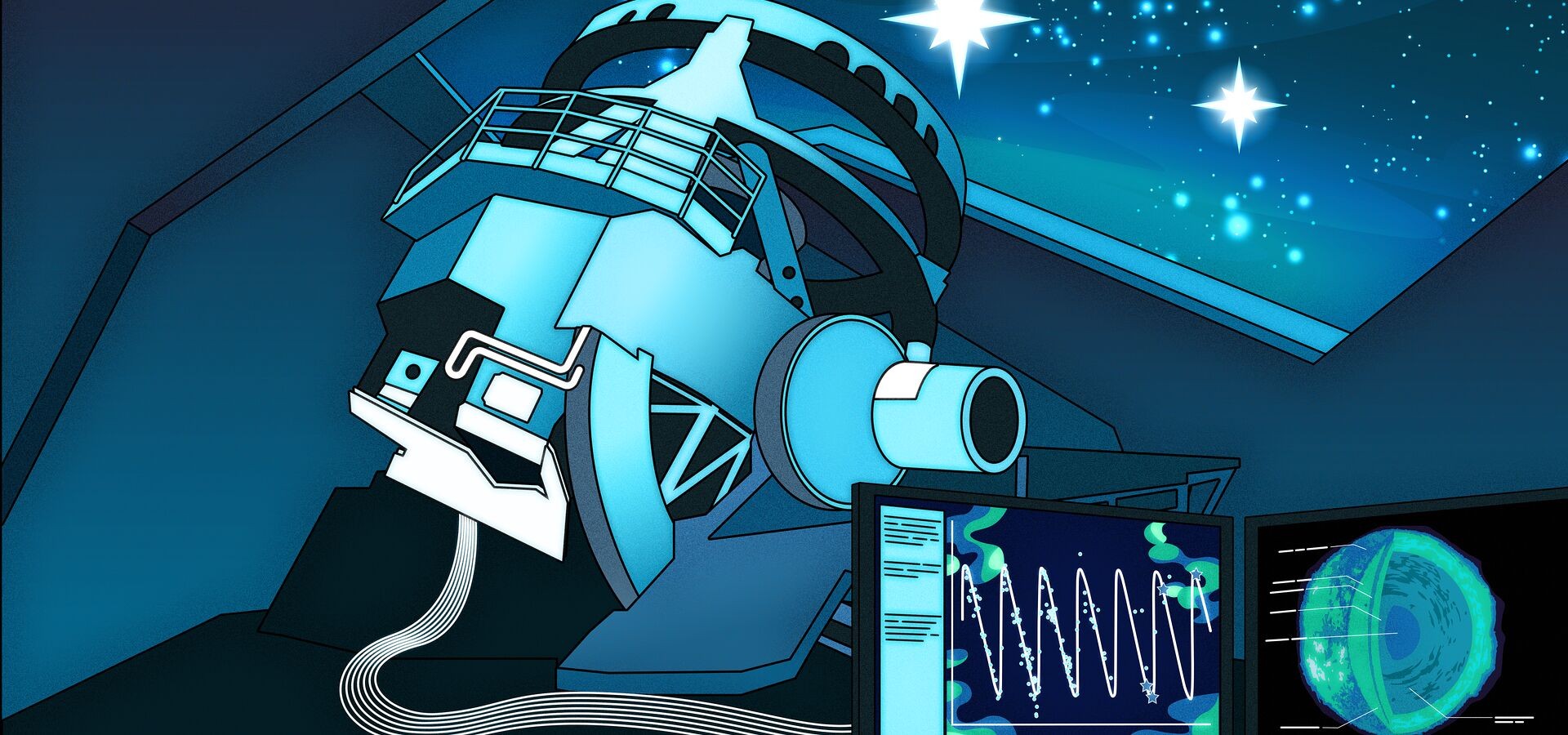
NSF–DOE Vera C. Rubin Observatory Will Unlock New Understanding of Variable Stars
The night sky might seem peaceful and still, but in fact millions of changes occur every night. Some of these changes are due to variable stars, which are stars that increase and decrease in brightness over time. These fluctuations can be the result of internal changes, such as the star swelling and shrinking, or external factors, such as the star being eclipsed by another star or a planet. Since the discovery of variable stars in the 1600s, scientists have used their rhythmic pulses to study stellar composition and evolution, as well as map vast cosmic distances.
Despite the long history of variable star studies, there is still a plethora of untapped knowledge to be uncovered, from understanding the exact mechanisms driving intrinsic brightness variability to identifying the most distant star in the Milky Way Galaxy. With its ability to precisely measure the light of faint objects and monitor how they change in time, Vera C. Rubin Observatory is expected to open up an entirely new realm of variable star investigations.
Rubin Observatory is a joint program of NSF NOIRLab and DOE’s SLAC National Accelerator Laboratory, who will cooperatively operate Rubin.
Over 10 years Rubin Observatory will conduct the Legacy Survey of Space and Time (LSST), during which it will use the 3200-megapixel LSST Camera — the largest camera ever built — to image a different region of the southern hemisphere sky about every 40 seconds. By the end of this deep and wide survey, Rubin will have imaged each region about 800 times. In doing so, Rubin will create an ultra-wide, ultra-high-definition time-lapse record of the changing night sky that includes detailed information about millions of variable stars.
Scientists preparing to use Rubin data are excited about how it will revolutionize the way we study the Universe. “The transformative aspect of what Rubin will be doing is not just the scale but also the precision,” says Adam Miller, an astronomer at Northwestern University and Director of the LSST-Discovery Alliance Data Science Fellowship Program. “This is going to allow for a lot of science that before now has been very difficult to accomplish, specifically for a field that I like to study: variable stars.”
It’s estimated that Rubin will detect around 100 million variable stars throughout its survey. This will allow for unprecedented studies into what drives variable stars’ changes, which remains a mystery for many variable stars despite the long history of studies in this field.
“Most of what we know about stars is from the light that they emit,” says Miller. “However, the only emission that we can see comes from the outermost layers of the star whereas all the nuclear fusion happening inside the core of the star cannot be observed directly. It's almost like trying to understand how blood flows through the human body while only being able to look at the skin.”
With its ability to take extremely precise measurements of variable stars as they change in brightness over minutes, days, and years, Rubin will enable detailed investigations into their light patterns and allow scientists to study the intrinsic mechanisms driving their variability. “There are stars for which very precise measurements of the pulsations that happen in their outer layers directly tell us about what's happening in their core,” says Miller. “To date this has been extremely challenging for some stars, in particular massive stars, but Rubin will detect these in both the Milky Way and other nearby galaxies.”
In addition to providing insight into stellar life and evolution, variable stars are also used for making accurate distance measurements to study the Universe’s expansion and evolution. In the early 1900s astronomer Henrietta Swan Leavitt, working with a team of women ‘computers’ at the Harvard College Observatory, discovered that Cepheid variable stars possess an intrinsic brightness that is proportional to its period of variability. This intrinsic brightness, or luminosity, can be compared to a star’s observed brightness to yield its distance from Earth. Astronomers continue to rely on the Cepheid period-luminosity relationship, now known as Leavitt’s Law, when measuring cosmic distances.
Although using variable stars to measure cosmic distances is one of the oldest astronomical tools, there are still limits that have not yet been reached. “We still don't know the most distant star that is part of our Milky Way Galaxy,” says Miller. “But Rubin has the potential to answer that question for us.”
Rubin’s rapid observing cadence will produce approximately 20 terabytes of data every night. In addition to this data, Rubin’s processing pipelines will produce another 15 petabytes of data catalogs. By the end of its 10-year survey, Rubin data processing will generate around 500 petabytes of data, which is equivalent to the total amount of content written in every language throughout human history.
This extraordinary influx of data will immediately outpace all previous efforts to catalog variable stars. And Rubin’s ability to detect faint objects means it will catalog millions of variable stars that have never been detected before. With this vastly expanded census, scientists will be able to conduct statistical investigations into their varying nature and refine their periodic variability over longer periods of time.
“With every dataset that Rubin releases to the scientific community and public, our variable star science will get better because we’ll have significantly more information about how these objects vary over time,” says Miller. “Entirely new subfields of astronomy may be launched as discoveries emerge from this data. It’s likely Rubin will find things that no one has even predicted to exist before.”
More Information
NSF–DOE Vera C. Rubin Observatory, funded by the U.S. National Science Foundation and the U.S. Department of Energy’s Office of Science, is a groundbreaking new astronomy and astrophysics observatory under construction on Cerro Pachón in Chile, with first light expected in 2025. It is named after astronomer Vera Rubin, who provided the first convincing evidence for the existence of dark matter. Using the largest camera ever built, Rubin will repeatedly scan the sky for 10 years and create an ultra-wide, ultra-high-definition, time-lapse record of our Universe.
NSF–DOE Vera C. Rubin Observatory is a joint initiative of the U.S. National Science Foundation (NSF) and the U.S. Department of Energy’s Office of Science (DOE/SC). Its primary mission is to carry out the Legacy Survey of Space and Time, providing an unprecedented data set for scientific research supported by both agencies. Rubin is operated jointly by NSF NOIRLab and SLAC National Accelerator Laboratory. NSF NOIRLab is managed by the Association of Universities for Research in Astronomy (AURA) and SLAC is operated by Stanford University for the DOE. France provides key support to the construction and operations of Rubin Observatory through contributions from CNRS/IN2P3. Rubin Observatory is privileged to conduct research in Chile and gratefully acknowledges additional contributions from more than 40 international organizations and teams.
The U.S. National Science Foundation (NSF) is an independent federal agency created by Congress in 1950 to promote the progress of science. NSF supports basic research and people to create knowledge that transforms the future.
The DOE’s Office of Science is the single largest supporter of basic research in the physical sciences in the United States and is working to address some of the most pressing challenges of our time.
NSF NOIRLab, the U.S. National Science Foundation center for ground-based optical-infrared astronomy, operates the International Gemini Observatory (a facility of NSF, NRC–Canada, ANID–Chile, MCTIC–Brazil, MINCyT–Argentina, and KASI–Republic of Korea), NSF Kitt Peak National Observatory (KPNO), NSF Cerro Tololo Inter-American Observatory (CTIO), the Community Science and Data Center (CSDC), and NSF–DOE Vera C. Rubin Observatory (in cooperation with DOE’s SLAC National Accelerator Laboratory). It is managed by the Association of Universities for Research in Astronomy (AURA) under a cooperative agreement with NSF and is headquartered in Tucson, Arizona.
The scientific community is honored to have the opportunity to conduct astronomical research on I’oligam Du’ag (Kitt Peak) in Arizona, on Maunakea in Hawai‘i, and on Cerro Tololo and Cerro Pachón in Chile. We recognize and acknowledge the very significant cultural role and reverence of I’oligam Du’ag to the Tohono O’odham Nation, and Maunakea to the Kanaka Maoli (Native Hawaiians) community.
SLAC National Accelerator Laboratory explores how the universe works at the biggest, smallest and fastest scales and invents powerful tools used by researchers around the globe. As world leaders in ultrafast science and bold explorers of the physics of the universe, we forge new ground in understanding our origins and building a healthier and more sustainable future. Our discovery and innovation help develop new materials and chemical processes and open unprecedented views of the cosmos and life’s most delicate machinery. Building on more than 60 years of visionary research, we help shape the future by advancing areas such as quantum technology, scientific computing and the development of next-generation accelerators. SLAC is operated by Stanford University for the U.S. Department of Energy’s Office of Science.
Contacts
- Adam MillerLSST-Discovery Alliance Data Science Fellowship Program DirectorNorthwestern University
- Bob BlumDirector for OperationsVera C. Rubin Observatory / NSF NOIRLab
- Željko IvezićDirector of Rubin Construction / Professor of AstronomyAURA / University of Washington
- Josie FenskeJr. Public Information OfficerNSF NOIRLab
- Manuel GnidaHead of External CommunicationsSLAC National Accelerator Laboratory