
Remote Eyes on the Sky: Inside SLAC’s Rubin Control Room
In the Rubin control room at SLAC, scientists watched in awe as the very first image captured by the LSST Camera appeared on their screens. With full operations set to begin this fall, the SLAC control room is becoming a vital hub for training, remote observing, and real-time support.
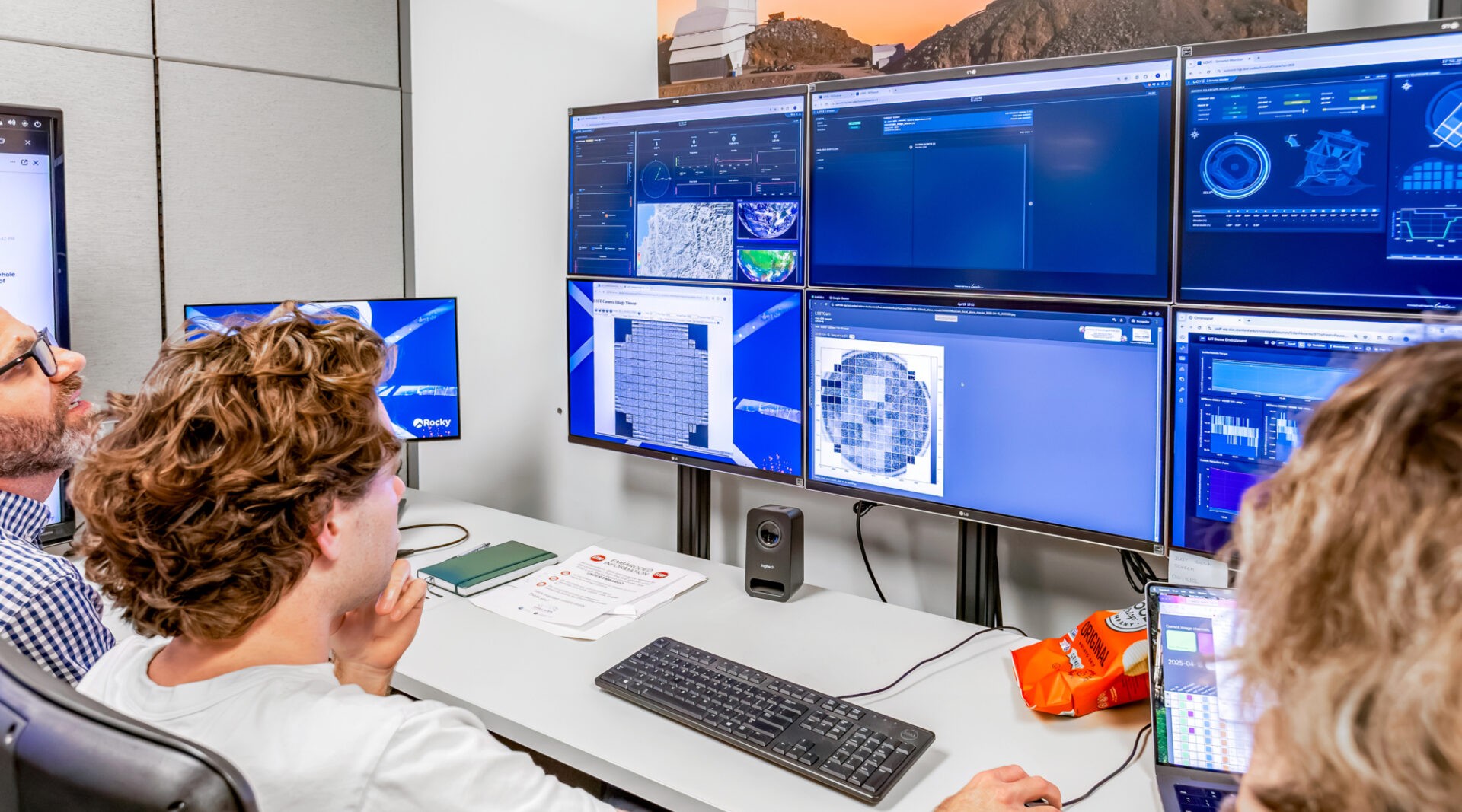
It’s April 2025, and the NSF–DOE Vera C. Rubin Observatory control room at the Department of Energy’s SLAC National Accelerator Laboratory is buzzing with activity. On the Menlo Park campus in California, on the first floor of the home of the Kavli Institute for Particle Astrophysics and Cosmology (KIPAC), you will find the lab’s Rubin Operations Center. There, a small group of scientists and engineers have gathered in front of a wall of oversized screens for a milestone moment: the witnessing of “First Photon,” the very first raw image captured by the Legacy Survey of Space and Time (LSST) Camera, built at SLAC and now installed on Rubin Observatory’s telescope in Chile.
All eyes are fixed on a live stream of data flowing from Cerro Pachón, thousands of kilometers away in northern Chile. Then, suddenly, it appears: an image of the night sky, freshly captured by the LSST Camera (LSSTCam). The image fills the screen, and smiles spread across the room. This is the very first LSSTCam on-sky image ever received in this room. The first of many to come.
But the Rubin control room at SLAC is more than a place of emotion and discovery.
Spread across six massive monitors is a mosaic of graphs, diagnostics, and real-time technical indicators: the camera’s focal plane, telescope orientation, temperature readings, weather conditions on the mountain, and more. A live video feed also maintains constant contact with the main control room at the observatory itself.
Rubin Observatory is jointly funded by the U.S. National Science Foundation and the U.S. Department of Energy’s Office of Science. Rubin is a joint program of NSF NOIRLab and DOE’s SLAC, who will cooperatively operate Rubin.
As one of the operating partners, SLAC is responsible for the stewardship of the LSST Camera. This covers everything from making sure the camera runs smoothly and is properly controlled to handling the stream of scientific data it collects. SLAC staff also provide both scientific and technical support for LSST Camera activities at the summit facility in Chile. Night-time operations are carried out by a team of observing specialists that includes both SLAC postdocs and full-time NOIRLab staff, working together on-site and remotely as part of the NOIRLab-led Rubin Summit Operations department.
With full science operations set to begin this fall, the Rubin control room at SLAC serves as a critical link in this chain, enabling training and real-time observing support from thousands of miles away. It is equipped with the same software and supervision tools as the summit’s main control room. But unlike the summit, it is just steps away from the engineers who built the camera and the data scientists who will soon analyze the data it produces. Two other similar rooms exist: one at the Rubin Base Facility in La Serena, Chile, and another at the NSF NOIRLab Headquarters in Tucson, Arizona.
Though commonly referred to as “control rooms,” these facilities are more accurately described as remote observing rooms: real-time operational stations directly connected to the observatory. They allow geographically distributed teams to monitor, collaborate, and intervene if needed, no matter where they are.
“It's like having a team of detectives,” says Phil Marshall, senior scientist at SLAC and deputy director for Rubin Operations. “Imagine the investigators out in the field, it's incredibly helpful to have someone back at headquarters, on the radio, helping them put the pieces together.”
The Rubin control room at SLAC also serves as a launchpad for the scientists who will eventually work on site in Chile. One of them is Shuang Liang, a postdoctoral researcher at SLAC and KIPAC, which has been a key intellectual incubator for the Rubin Observatory project from its first moments. Liang was the driving force behind assembling and commissioning the control room. He was also among the first to train in the control room where, over the course of one month, he mastered the skills needed to monitor the instruments and assess the quality of observations. Through this training, he became well-versed in key software tools such as the LSST Operations and Visualization Environment (LOVE), a centralized platform that allows observers to monitor the telescope’s systems, manage observation schedules, and track real-time data streaming from the summit. Like others in his cohort, Liang will spend two years stationed in Chile, devoting 80% of his time to observatory operations and 20% to his own research.
Now based in La Serena, Chile, as part of the team of observing specialists, Shuang rotates between daytime and night-long observation shifts in the main control room. “In the morning, we start by warming up the telescope’s components, examining the status of the dome, and making sure everything is ready to observe once the Sun sets,” he explains.
Once night falls, Shuang begins his late shift, from 8 p.m. until sunrise, actively supervising nightly observations. “We check the telescope focus and ensure everything runs smoothly. But we also have to make judgment calls, like closing the dome if weather conditions change. If it clouds over, gets foggy, starts to rain or there's high wind, we need to protect the instruments.” And when anomalies occur, he can contact a team of commissioning scientists and engineers, some on-site, others working remotely. “They know the system inside and out,” he says, “and they have the right contacts to troubleshoot quickly.”
The hands-on experience operating the instrument at the summit is invaluable for the postdocs. “It allows them to get a deep understanding of how the data is taken, where it comes from, and what the low-level problems with the data are,” Marshall explains. “That understanding feeds directly into their research and ultimately benefits the scientific community, especially the LSST Dark Energy Science Collaboration.” It is a model inspired by large-scale particle physics projects like the Large Hadron Collider at CERN, where postdocs work directly on detectors before diving into data analysis.
After completing their two-year stint in the summit control room, postdocs like Shuang will return to SLAC for another two-year term. This time, they will dedicate 80% of their time to research, in Shuang’s case, focusing on weak gravitational lensing cosmology. The remaining 20% will go toward operations support, including working shifts in the control room. Then, on the other side of the operation, they will provide remote support to the teams in Chile, helping troubleshoot issues and guide nightly observations from afar. From this quiet room in California, they will continue to help steer one of the most ambitious astrophysical endeavors of our time.