Página principal
Localizar el contenido del sitio
    • Acerca del Observatorio Rubin
    • Historia
    • ¿Quién era Vera Rubin?
      • Rubin en Chile
      • Cerro Pachón
      • Selección del emplazamiento del observatorio
      • Organización del observatorio
      • Liderazgo
      • Colaboraciones científicas
    • Información de financiamiento
      • Trabaje con nosotros
      • Trabajos
    • Información de contacto
    • Explore
    • Conceptos Básicos de Rubin
    • Objetivos científicos
      • Cómo funciona Rubin
      • Investigación del Espacio-Tiempo como Legado para la Posteridad (LSST)
      • Tecnología de Rubin
      • Flujo de alertas
      • Rubin en cifras
    • Voces de Rubin
      • Skyviewer ↗
      • Sobre Skyviewer
      • Skysynth: Skyviewer, sonificado
    • Orbitviewer ↗
    • Involúcrate en la Investigación de Rubin
      • Actividades, juegos y más
      • Juego Space Surveyors
      • Serie de videos animados
    • Galería
      • Galería Principal
      • Featured Media
      • Galería de Noticias
      • Primera Luz
      • Gráficos y Ilustraciones
      • Divulgación y Educación
      • Noticias de Imágenes
      • COSMOS de Rubin
      • Un Océano de Estrellas de Rubin
      • Primera Luz del Observatorio Vera Rubin
    • Presentaciones de Diapositivas
    • Construction Archive Gallery
    • Media Use Policy
    • Noticias
    • Comunicados de Prensa
    • Recursos de medios
    • Comunicados de Prensa
    • Pautas de Estilo
    • Para los científicos
    • Get started
      • Data Policy
      • Data policy slides
      • News, events, and deadlines
      • Rubin Science Assemblies
      • Rubin Data Academy
      • Rubin Community Workshop
      • Resources for scientists
      • Rubin Community Forum
      • Early Science Program
      • LSST Discovery Alliance
      • Workshops and seminars
      • Tutorials
      • Additional compute resources
      • Gemini time for alert follow-up
      • Public outreach materials
      • For amateur astronomers
      • Survey, instruments, and telescopes
      • Key numbers
      • Live status
      • The Legacy Survey of Space and Time (LSST)
      • Instruments
      • Telescopes
      • Data products, pipelines, and services
      • Data access and analysis
      • Recent data releases
      • Alerts and brokers
      • Data processing pipelines
      • User-contributed resources
      • Future data products
      • Simulation software
      • Documentation and publications
      • Technical documentation
      • How to cite Rubin Observatory
      • Publication policies
      • Glossary & Acronyms
      • Papers citing Rubin Observatory
      • Science Collaborations
      • Galaxies Science Collaboration
      • Stars, Milky Way, and Local Volume Science Collaboration
      • Solar System Science Collaboration
      • Dark Energy Science Collaboration
      • Active Galactic Nuclei Science Collaboration
      • Transients and Variable Stars Science Collaboration
      • Strong Lensing Science Collaboration
      • Informatics and Statistics Science Collaboration
    • Citizen Science
      • Committees and teams
      • Science Advisory Committee (SAC)
      • Survey Cadence Optimization Committee (SCOC)
      • Users Committee
      • Target of Opportunity (ToO) Advisory Board
      • Resource Allocation Committee (RAC)
      • Community Science Team (CST)
      • Research Inclusion Working Group (RIWG)
      • Project Science Team (PST)
      • In Kind Program
      • In-Kind Program FAQs
      • Frequently Asked Questions
      • Impacts from artificial satellites and debris
      • How to navigate this website
      • Code of Conduct
      • Interim CoC
    • Educación
    • Primera Luz: Recursos que Dejan Huella en el Aula
    • Preguntas frecuentes - Educación
    • Educadores
    • Glosario
    • Investigaciones
    • Calendario
Localizar el contenido del sitio
Esta página aún no se ha traducido a su idioma; se muestra la versión en inglés.

Conecta con nosotros

  • Visite el Observatorio Rubin en Facebook
  • Visite el Observatorio Rubin en Instagram
  • Visite el Observatorio Rubin en LinkedIn
  • Visite el Observatorio Rubin en Twitter
  • Visite el Observatorio Rubin en YouTube
  • Contáctenos
  • Trabaja con nosotros
  • Intranet (en inglés)
  • Guía de identidad visual (en inglés)
  • Política de privacidad

La Fundación Nacional de Ciencias (NSF) y la Oficina de Ciencias del Departamento de Energía (DOE) apoyarán al Observatorio Rubin en su fase de operaciones para conducir la Investigación del Espacio-Tiempo como Legado para la Posteridad. También apoyarán la investigación científica con los datos. Durante sus operaciones, el financiamiento de la NSF lo administra la Asociación de Universidades para la Investigación en Astronomía (AURA, por su sigla en inglés) bajo un acuerdo colaborativo con la NSF, y el financiamiento del DOE lo administra Laboratorio Nacional de Aceleradores SLAC (SLAC, por su sigla en inglés), bajo un contrato con el DOE. El Observatorio Rubin es operado por el Laboratorio Nacional de Investigación para la Astronomía Óptica-Infrarroja de la NSF (NOIRLab) y por el SLAC.

La NSF es una agencia independiente creada por el Congreso de los Estados Unidos en 1950 para promover el progreso de la ciencia. La NSF apoya la investigación básica y las personas para crear conocimiento que contribuya a la transformación del futuro.

La oficina de Ciencias de DOE es la mayor fuente de financiamiento de la investigación básica en ciencias físicas en los Estados Unidos y está trabajando para hacer frente a algunos de los retos más desafiantes de nuestro tiempo.

  1. Noticias
  2. Rubin Auxiliary Telescope Makes its First Observations

Multimedia

Noticias relacionadas

Cargando las noticias...
Volver a noticias

Rubin Auxiliary Telescope Makes its First Observations

30 de marzo de 2022
The telescope measures atmospheric transmission and tests a lot of the systems that will be used with the main telescope in Rubin Observatory

At the end of January 2020, the Rubin Observatory Auxiliary Telescope spectrograph made its first observations of astronomical objects on Cerro Pachón! These "first light" images represent real, usable data for Rubin Observatory, and are the results of years of hard work by many people across the Rubin project.

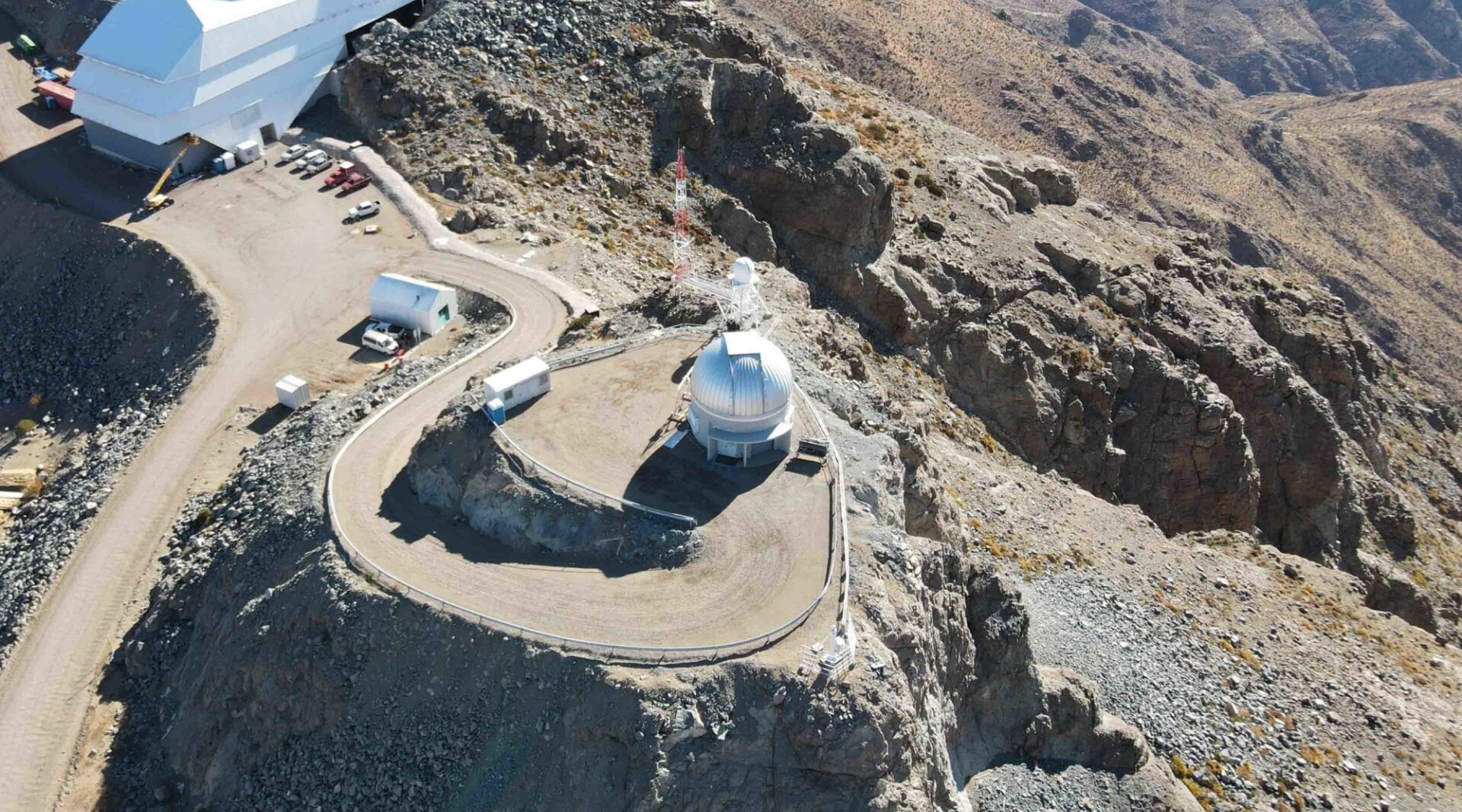
The Auxiliary Telescope, or AuxTel, is a part of Rubin Observatory and sits on a hilltop close to the main facility. It uses a spectrograph, which was installed in January, to study the effect of the atmosphere on the light coming from distant stars and galaxies. By using these measurements we will be able to improve the quality of the data from the main telescope. This has the effect of eliminating one source of error in our measurements, which leads to more and better science.

How does the atmosphere affect telescope data? There are a lot of elements in the atmosphere (including water, oxygen, and ozone) that can distort the light detected by a ground based observatory like Rubin. Aerosols like sea salt, dust from volcanoes, and smoke from forest fires can distort light too. How much of these substances are above the telescope varies from night to night, and the Auxiliary Telescope will provide this important complementary data for Rubin throughout the entire 10-year survey. If we know how much, and in what way, light is being distorted by the atmosphere above the telescope, we can correct for this distortion during data processing. The goal is to make Rubin data as accurate as possible!